
If your hospital is preparing for NABH, you have probably heard the word “PDCA” in a meeting. Maybe nobody explained it properly.
This guide explains what PDCA is, shows you one complete example from a real ward problem, and tells you how to run your own first cycle. It is written for nurses who are already working – ANMs, GNMs, and B.Sc. Nurses working in hospitals or in community health centres.

What is the PDCA cycle in nursing?
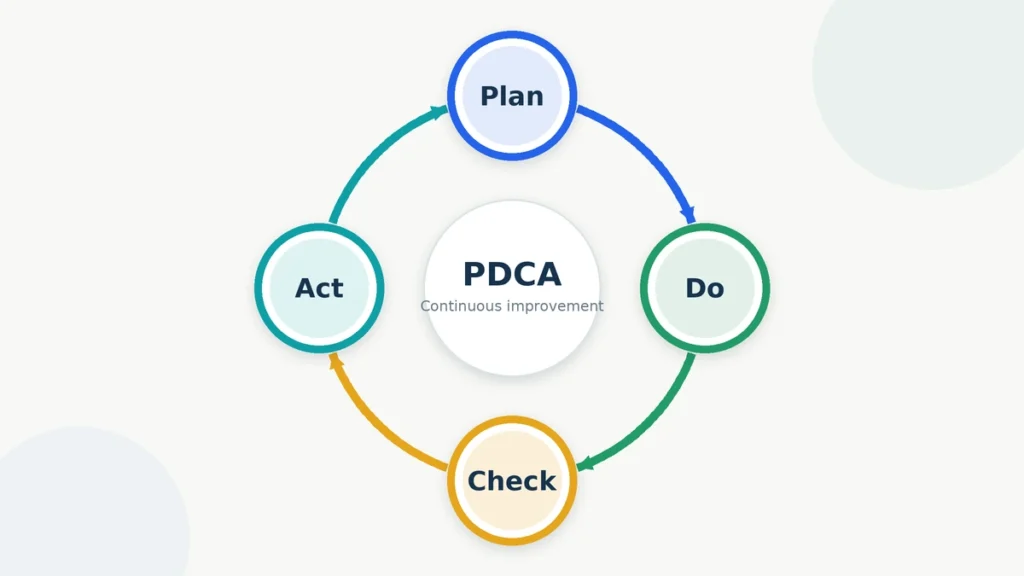
PDCA stands for Plan, Do, Check, Act. The plan-do-check-act cycle is a four-step method for making a small change, testing it, measuring whether it worked, and then either keeping it or trying something else.
In nursing, it is used to fix everyday care problems: high infection rates, patient falls, and medication errors in a way that is planned and measured, not guesswork.
The most important idea is this: you test the change on a small scale first. You do not change the whole hospital and hope.
Where did PDCA come from?
The plan-do-check-act method began with Walter Shewhart in the 1930s and was made famous by W. Edwards Deming, who taught it to Japanese industry after the Second World War. It is sometimes called the Deming cycle or the Shewhart cycle.
Healthcare borrowed it because the problem is the same. A hospital, like a factory, has processes that repeat many times a day. When a process is weak, the same mistake recurs.
PDCA finds the weak step and fixes it. It now sits alongside other quality improvement strategies used in healthcare such as Six Sigma, Lean, and root cause analysis.
What do the four stages mean?
| Stage | What you do | Ask yourself |
|---|---|---|
| Plan | Find the problem. Find its real cause. Set a clear, measurable goal. Decide what you will change. | What exactly is going wrong, and why? |
| Do | Try the change on a small scale — one ward, one shift, a few weeks. Record what happens. | Did we actually do what we planned? |
| Check | Compare the numbers before and after. Ask the staff what they noticed. | Did it work? By how much? |
| Act | If it worked, make it the new normal and write it into your ward procedure. If it did not, change the plan and run the cycle again. | Do we keep this, fix it, or drop it? |
The cycle does not end. After Act, you plan again. That is why it is drawn as a circle.
A complete PDCA example – Improving hand hygiene on your ward
This is what one full cycle looks like in practice.

Plan
Your ward’s hand hygiene compliance is measured at 62%. The NABH benchmark most Indian hospitals work to is above 80%.
You watch for three days and ask five simple questions of the staff. You find two real causes: the alcohol rub dispensers at the far end of the ward are usually empty, and new nursing staff were never shown the moments for hand hygiene.
Your goal: raise ward hand hygiene compliance from 62% to above 80% in eight weeks.
Your change: refill dispensers twice daily instead of once, add two dispensers near the beds farthest from the sink, and run one 20-minute teaching session for all ward staff.
Do
You run it on one ward only for eight weeks. One senior nurse checks the dispensers each morning and each evening and signs a small register. You hold the teaching session in the first week and repeat it once for the night staff.
Check
You observe hand hygiene at the same times of day as before, so the comparison is fair.
| Before | After 8 weeks | |
|---|---|---|
| Compliance | 62% | 84% |
| Empty dispensers found | 9 in 3 days | 1 in 3 days |
Staff tell you the extra dispensers helped most. The teaching session helped the new nurses, but the experienced staff already knew the moments.
Act
It worked, so you make it permanent. Twice-daily dispenser checks go into the ward’s written procedure. The teaching session becomes part of induction for every new nurse. You then share the result with the quality team so other wards can copy it.
Then you begin the next cycle – perhaps on a different problem.
Notice what made this work. The problem was specific. The cause was found by looking, not guessing. The goal had a number and a date. The test was small. The measurement was fair. And the change was written down so it does not disappear when you go on leave.
Which hospital problems can you use PDCA on?
Almost any repeating problem that can be counted. Indian hospitals working towards NABH accreditation commonly track the indicators below, and each one is a good PDCA target.
| Indicator | How it is usually measured | Common benchmark |
|---|---|---|
| Hand hygiene compliance | Observed audits | Above 80% |
| Patient falls | Falls per 1,000 patient days | Below 3.0 |
| Medication errors | Errors ÷ total prescriptions × 100 | Below 0.5% |
| Pressure ulcers (bed sores) | New ulcers ÷ patients at risk × 100 | Below 2% |
| Needlestick injuries | Injuries per 1,000 patient days | Below 1.0 |
| Catheter-associated UTI (CAUTI) | Per 1,000 catheter days | Below 5 |
| Ventilator-associated pneumonia (VAP) | Per 1,000 ventilator days | Below 5 |
| Surgical site infection | Percentage of surgeries | Below 3% |
| Patient identification errors | ID errors ÷ admissions × 100 | Zero |
Benchmarks vary between hospitals and between NABH editions. Always confirm the current target with your own quality department before you set a goal.
Start with the indicator your hospital is already measuring. You will have past data to compare against, which makes your Check stage far easier. Nurses who work on infection-related indicators regularly often build deeper expertise through an infection control nurse course.
How do you run your first PDCA cycle?
- Pick one small problem. Not “improve patient safety.” Something like “reduce empty hand-rub dispensers on our ward.” A narrow problem is easier to fix and easier to prove.
- Measure it before you change anything. If you have no starting number, you cannot show improvement. Even three days of counting is enough to begin.
- Find the real cause. Ask “why” until you reach something you can actually change. Talk to the staff doing the work — they usually know.
- Write a goal with a number and a date. “From 62% to above 80% in eight weeks.”
- Test small. One ward, one shift, a few weeks. Keep a simple register.
- Measure the same way again. Same times, same method, same observer if possible.
- Decide. Keep it, change it, or drop it — then write down what you decided and why.
The whole thing can take six to twelve weeks. Your first cycle will be untidy. That is normal, and it is not a reason to stop.
Which tools do you use in the Plan stage?
You do not need software. Three simple tools cover most situations.
The 5 Whys
Keep asking “why” until you reach the real cause.
A patient received the wrong dose. Why? The nurse misread the vial. Why? Two vials look almost the same. Why? They are stored next to each other. Why? There is no rule about where each drug is kept.
Root cause: no storage rule for look-alike drugs.
Notice the answer is a system problem, not a careless nurse. That is the point of the exercise, and it is the same logic behind how quality control nurses prevent errors before they reach the patient.
The fishbone diagram
Draw a horizontal line with the problem at the head. Add branches for the usual sources of trouble: people, processes, equipment, environment, and materials. Under each branch, list what could be going wrong. It helps a team see causes they would otherwise argue about.
SMART goals
A good goal is Specific, Measurable, Achievable, Relevant, and Time-bound. “Improve hand hygiene” is not a goal. “Raise ward compliance from 62% to above 80% in eight weeks” is.
What is the difference between PDCA and PDSA?
You will meet both. They are almost the same method.
| PDCA | PDSA | |
|---|---|---|
| Third stage | Check | Study |
| Emphasis | Did the result match the target? | What did we learn, including the unexpected? |
| More common in | Industry, ISO, NABH documentation | Healthcare research and improvement science |
The word “Study” was chosen to encourage teams to look at why something happened, not only whether the number moved. In everyday hospital use, most people treat them as the same thing. If your hospital says PDCA, use PDCA.
Can ANM and GNM nurses run PDCA projects?
Yes. There is no rule that quality improvement belongs only to B.Sc. or M.Sc. nurses.
PDCA is a way of thinking, not a qualification. What it needs is someone close enough to the work to see where it goes wrong – and that is usually the nurse doing it, not the manager above her.

This matches what patient safety research consistently finds: nurses detect errors and near misses because they are the constant presence at the bedside.
In practice:
- ANM nurses work mostly in sub-centres, primary health centres and community programmes. PDCA fits immunisation session attendance, antenatal check-up follow-up, cold chain checks, and record accuracy.
- GNM nurses work mostly in hospital wards. PDCA fits hand hygiene, falls, medication safety, handover quality, and infection control.
If you are the person who noticed the problem, you are the right person to run the cycle. You may need a senior nurse or the quality department to approve it, and that is worth asking for early — it protects you, and it gets you support.
Does PDCA work in small hospitals and PHCs?
Yes, and in some ways it is easier there.
Small units have fewer people to coordinate and shorter decision chains. You do not need a dashboard, an electronic record system, or a quality department. A register, a pen, and a fair method of counting are enough for a first cycle.
Public facilities have their own framework for this. India’s National Quality Assurance Standards (NQAS) set out the areas of concern that district hospitals, CHCs and PHCs are assessed against — and a PDCA cycle is one of the simplest ways to show improvement against them.
What small units often lack is past data. If nothing has been counted before, spend your first two weeks simply counting. That baseline is what turns your later claim into evidence.
What does the research say?
PDCA has been studied in real nursing settings, though most published work comes from outside India.
Published research includes a systematic review of PDCA in nursing care quality (Enfermería Clínica, 2021) and studies applying PDCA to areas such as chemotherapy day ward safety and haemodialysis nursing care.

One peer-reviewed report describes an intensive care unit caring for severely ill COVID-19 patients, where nine PDCA-based measures — including clean and contaminated zoning, standardised drug storage, defined staff roles, structured handover, and visual reminder boards — improved staff role clarity and infection awareness within two weeks.
Two honest points about this evidence. Most studies are small and from single hospitals, so results do not automatically transfer. And very little of this research is Indian, which means the method is well supported in general but under-studied in Indian conditions.
That is a reason to measure your own results carefully — not a reason to avoid the method.
Common mistakes nurses make with PDCA
- Choosing a problem that is too big. “Improve patient safety” cannot be measured or finished.
- Not measuring before you start. Without a baseline, you can never prove improvement.
- Blaming a person instead of the process. If your root cause is “the nurse was careless,” you have not finished asking why.
- Changing several things at once. If you change four things and the number improves, you will never know which one worked.
- Skipping the Check stage. This is the most common failure. People make the change, feel good, and never measure.
- Measuring differently before and after. If you observed at 9 a.m. before and at 3 p.m. after, your comparison is worthless.
- Not writing it down. An improvement that lives only in one nurse’s memory disappears when she transfers.
- Stopping after one cycle. PDCA is a circle. One turn is a start, not a finish.
What should you record for NABH?
Assessors look for evidence that improvement is a habit, not a one-off before the visit. Most hospitals are expected to show several months of trend data. Keep it simple and keep it consistent:
- The problem you chose and why
- Your baseline figure, with the date and how you measured it
- Your goal, with its number and deadline
- What you changed, and when
- Your follow-up figure, measured the same way
- What you decided afterwards — keep, change or drop
- The updated ward procedure, if you changed one
A single-page record per cycle is enough. What matters is that the dates are real and the method is consistent. You can check the current chapter structure and objective elements on the official NABH standards page.
How does PDCA help your nursing career?
Most nurses move into quality work from inside the hospital, not by applying from outside. A nurse who has run two or three documented PDCA cycles has something specific to show — and that is what separates a candidate from a CV.
It is the practical foundation for roles like quality control nurse, NABH coordinator, infection control nurse, and clinical audit nurse. It also helps in any senior ward role, because a nurse who can find a root cause and fix a process is useful everywhere — which is why it appears in almost every list of essential nursing administration skills.
Start by joining your hospital’s infection control or quality committee. Ask to help with the next audit. That is how most people begin. If you are also weighing longer-term study options, our guide to high-salary medical diploma courses covers the wider career picture.
Conclusion: How to learn PDCA properly
You can start your first cycle with what is in this guide. If you want structured training in quality and infection control alongside your job, Global A1 Institutes runs online certification courses for working nurses, including Infection Control Nurse and Nursing Administration. Online study means you can continue in your current post while you learn. Course details, duration, and fees are listed on the course pages.
Not sure which specialisation fits your goal? Talk to our admissions team.
Glossary
| Term | Plain meaning |
|---|---|
| Baseline | The measurement you take before you change anything |
| Benchmark | The target number you are trying to reach |
| CAPA | Corrective and Preventive Action: fixing a problem and stopping it from returning |
| Compliance | How often staff actually follow the rule |
| Indicator | A number a hospital tracks regularly to watch quality |
| NABH | National Accreditation Board for Hospitals & Healthcare Providers — India’s hospital accreditation body |
| Patient days | Total number of days all patients spent in hospital; used to compare wards fairly |
| Pilot | A small test before a full rollout |
| Root cause | The real underlying reason, not the surface symptom |
| SOP | Standard Operating Procedure — the written steps for a task |
Frequently asked questions
What is an example of PDCA in nursing?
Raising hand hygiene compliance from 62% to above 80% by refilling dispensers twice daily, adding dispensers near distant beds, and training staff — then measuring again after eight weeks the same way you measured before.
How long does one PDCA cycle take?
Usually six to twelve weeks for a ward-level project. Simple changes can be tested in four. Rushing the Check stage is the most common mistake.
What is the difference between PDCA and PDSA?
Only the third stage. PDCA says “Check” — did the result meet the target? PDSA says “Study” — what did we learn, including things we did not expect? In daily hospital use, they are treated as the same method.
Can an ANM nurse do a quality improvement project?
Yes. There is no qualification barrier. ANM nurses can apply PDCA to immunisation attendance, antenatal follow-up, cold chain checks, and record accuracy in sub-centres and PHCs.
What if my PDCA cycle fails?
That is a normal result, not a failure of the method. A cycle that does not work tells you the cause was wrong or the change was too weak. You adjust the plan and run it again — that is the Act stage doing its job.
Does NABH require PDCA specifically?
NABH requires continuous quality improvement and evidence that you monitor and act on quality indicators. PDCA is the most widely used method for showing that, but check your own hospital’s documented process.
Do I need a certificate to use PDCA?
No. You can run a cycle tomorrow with a register and a pen. A certification helps when you want to move into a formal quality role, because it shows you know the wider method.
References
- ASQ — The PDCA Cycle
- AHRQ — Tools and Strategies for Quality Improvement and Patient Safety
- AHRQ PSNet — Nursing and Patient Safety
- The effectiveness of PDCA method implementation in improving nursing care quality: a systematic review — Enfermería Clínica, 2021
- NABH — National Accreditation Board for Hospitals & Healthcare Providers
- NABH — Explore Standards (including Nursing Excellence)
- WHO — Patient Safety
- NHSRC — National Quality Assurance Standards