Direct Answer: Infection Control Nurse Certification helps nurses develop the knowledge and skills needed to prevent infections, follow hospital safety protocols, and promote safer patient care.

Healthcare-associated infections (HAIs) are infections that patients acquire while receiving healthcare. According to the World Health Organization (WHO), in acute-care hospitals, around 7 out of every 100 patients in high-income countries and 15 out of every 100 patients in low- and middle-income countries acquire at least one HAI during their hospital stay.
WHO also reports that effective infection prevention and control (IPC) measures—including proper hand hygiene and access to clean water, sanitation, and hygiene services – can reduce the risk of HAIs by up to 70%.
Practices such as proper hand hygiene, correct use of personal protective equipment (PPE), and safe cleaning and disinfection procedures play an important role in reducing infection risks.
This guide explains why Infection Control Nurse Certification matters, what skills nurses can develop, and how this training can support their professional growth.
Why Is Infection Control Nursing Important in Hospitals?
Because a hospital puts sick people, open wounds, tubes and strong antibiotics in one room. Germs spread easily there, and someone has to watch constantly.
Preventing Healthcare-Associated Infections (HAIs)
An HAI is an infection a patient did not have on arrival. The common ones:
- Ventilator-associated pneumonia (VAP), a lung infection from a breathing machine
- Catheter-associated urinary tract infection (CAUTI), from a urinary tube
- Central line-associated bloodstream infection (CLABSI), from a deep vein tube
- Surgical site infection (SSI), a wound infection after surgery
Most are linked to a device or a procedure. Change the habit, and the risk falls.
What Does an Infection Control Nurse Do?
They watch how care is given, find the gaps, and help fix them. The job is part teaching, part checking, part record-keeping.
India’s National Guidelines for Infection Prevention and Control in Healthcare Facilities, from the Ministry of Health and Family Welfare with the National Centre for Disease Control, say “A full-time nursing staff should be appointed as the ICN,” and advise “a minimum ratio of one full-time ICN per 250 beds.”
They also say the ICN “should have training in IPC, preferably through an accredited course.”
Key Responsibilities of an Infection Control Nurse
- Monitoring infection prevention practices. Checking hand hygiene, dressing changes and device care.
- Educating healthcare staff. Short sessions for nurses, housekeeping staff and new joiners.
- Supporting infection surveillance and audits. Collecting data, filling forms, reporting findings.
- Helping implement outbreak-control measures. Acting fast when patients catch the same germ.
- Promoting hand hygiene, PPE use, and safe patient care. The basics, until they stick.
The guidelines are blunt about which basic matters most: “hand hygiene is the single most important measure for prevention of infection.”
Enhanced Professional Credibility and Recognition
Demonstrating Specialised Infection Prevention Knowledge
Many nurses already do infection control work. Few can show on paper that they studied it. A certificate with a real syllabus behind it shows you covered surveillance, sterilisation, waste handling and outbreak response.
Be clear what it proves. It shows you finished a course. Your work record shows how you perform.
Building Trust Through Effective Teamwork
Infection control only works when people listen to you.
Much of this job is asking a busy colleague to stop and clean their hands, or telling a senior doctor that a dressing was changed wrongly. That goes better when you can explain why: which germ, which route, which guideline. Colleagues then hear a reason, not a complaint.
Advanced Knowledge and Skill Development
Hand Hygiene, PPE, and Standard Precautions
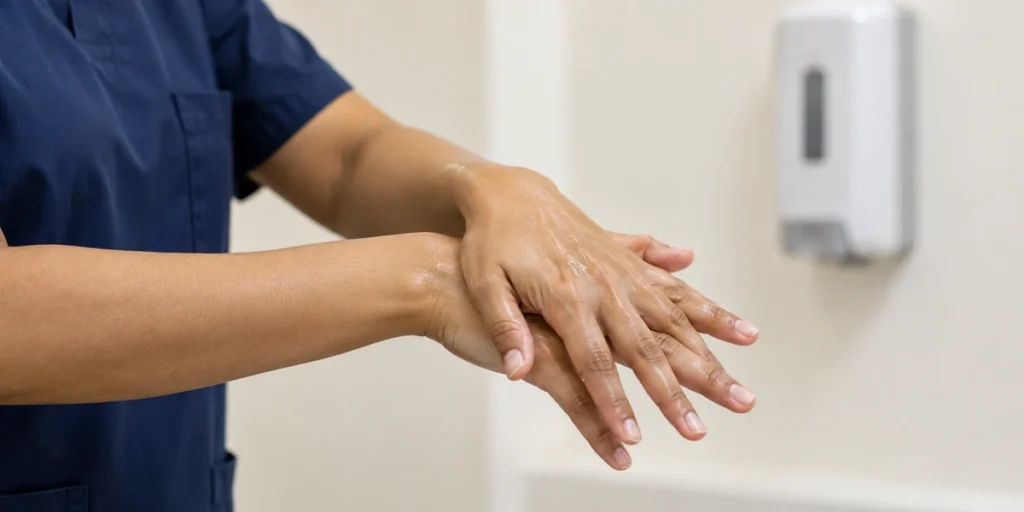
Standard precautions are the safety steps you use with every patient, infected or not. You treat blood and body fluids as if they carry germs.
Training covers when to clean your hands, and when gloves, gown, mask or eye cover are needed. It also covers what PPE (personal protective equipment) cannot do. Gloves do not replace hand hygiene, and worn wrongly they spread germs.
Cleaning, Disinfection, Sterilisation, and Biomedical Waste Management
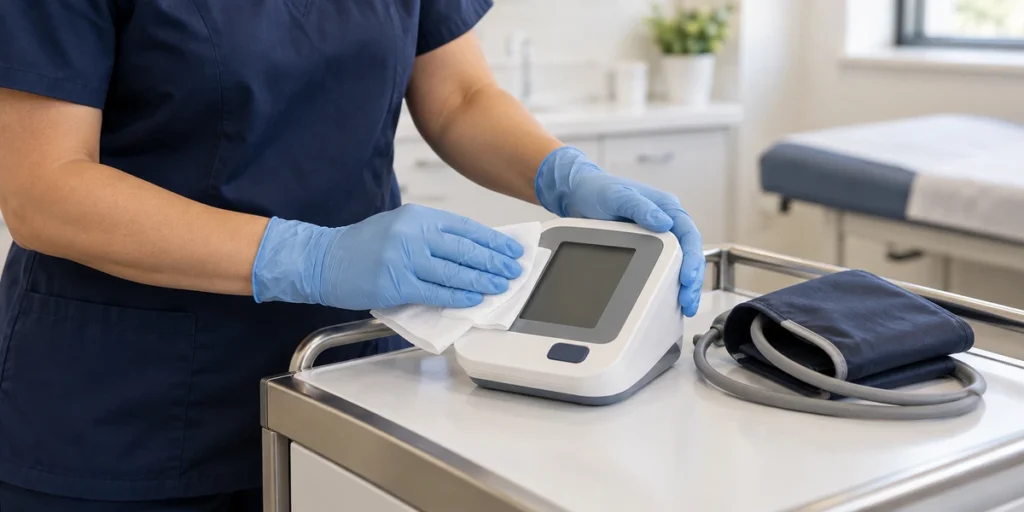
These four words are often used as if they mean the same thing. They do not.
- Cleaning removes visible dirt.
- Disinfection kills most germs on a surface or instrument.
- Sterilisation destroys all microbes, including tough spores.
- Biomedical waste management is the safe sorting, storage and disposal of hospital waste.
In India, hospital waste must go into colour-coded bags and bins under the Bio-Medical Waste Management Rules, 2016. A sharp item in the wrong bag puts housekeeping and waste staff at direct risk.
Infection Surveillance, Outbreak Response, and Audit Reporting

Surveillance means tracking infections over time, so you see a pattern instead of a single case. Without it, an outbreak looks like bad luck. With it, you see three patients on one ward grow the same germ in a week, and act before it becomes ten.
Audits are the other half. You check whether a protocol is really followed and report it. An audit only helps if you record what is really happening.
Applying Infection Prevention Guidelines in Indian Hospitals
Most infection control material online is written for American hospitals and quotes American regulators. Useful background. Not what an Indian hospital is checked against.
In India, three things apply: the national IPC guidelines from MoHFW and NCDC, the Bio-Medical Waste Management Rules, and your hospital’s own protocols. Hospitals seeking NABH accreditation are also assessed on infection control standards.
The protocol comes first in daily practice. A guideline gives the principle; the protocol tells you what to do on your shift.
Improved Career Advancement Opportunities
Where Can Infection Control Nurses Work in India?
IPC knowledge is used in more places than nurses expect:
- Hospital infection control teams and committees
- Intensive care units, where device-related infections are most common (see certifications every critical care nurse should consider)
- Operation theatres and central sterile supply departments
- Quality and patient-safety teams, including accreditation work alongside quality control nurses
- Dialysis units and oncology day-care
Since the guidelines advise one full-time ICN per 250 beds, larger hospitals need dedicated people for this. Nurses moving into ICU or quality roles can also look at our Critical Care Nurse course and Quality Control Nurse course.
How Can ICN Training Support Career Development?
Honestly, by making you a stronger candidate. Not by handing you a post.
Training gives you structure and vocabulary. You can describe your work in the words a hiring manager uses: surveillance, bundle compliance, audit, outbreak response. You can also apply as a specialised nurse, not a general one.
It cannot promise a promotion, a job or a salary rise. Anyone who says a three-month course guarantees that is selling.
Stronger Patient Safety Outcomes
How Infection Prevention Training Supports Safer Patient Care
Most infection prevention is not complicated. It is small things done correctly, every time, by tired people on long shifts. Training shows you which steps matter most, and gives the reason behind each one. The reason is what makes a habit hold.
What Does Indian Research Say About Infection Control Nurses?
Recent Indian research highlights why specialised infection prevention training and dedicated infection control staff matter in hospitals.
A 2026 multicentre study of infection prevention programmes in 31 Indian healthcare institutions found that although 74.5% reported providing healthcare-associated infection (HAI) training, only 27.5% benchmarked HAI data, highlighting gaps in infection monitoring.
Similarly, a 2025 study involving 60 nurses across five hospitals in Uttar Pradesh found that structured infection-prevention training significantly improved nurses’ knowledge, attitudes, and practices.
A 2026 study on infection control nurse staffing in 36 hospitals in Karnataka also identified gaps in public-sector hospitals: only two surveyed public hospitals had certified infection control nurses. However, its data were collected between 2020 and 2023, despite publication in 2026.
What does this mean? Indian research supports the need for structured infection-prevention training, better infection monitoring, and dedicated infection control roles. However, these studies do not prove that one specific certification alone reduces infection rates or deaths.
Professional Networking and Continuous Learning
Learning From Healthcare Teams and Updated Guidelines

Guidelines change. Germs change. What you learned five years ago may not be current practice. Follow the bodies that issue the guidance, read your hospital’s updated protocols, and talk to people doing the same work elsewhere. IPC sits between nursing, microbiology, housekeeping and administration, so most learning comes from those conversations.
How to Choose the Right Infection Control Nurse Certification Course
Check the Course Syllabus and Learning Format
Ask for the module list before you pay. A serious syllabus names its topics instead of describing them vaguely. Then ask:
- Who teaches it? Named faculty you can look up, or nobody in particular?
- Is there an exam? If everyone passes, the certificate carries little weight.
- What is the format? Live classes, recorded lectures, or only reading material?
- What happens afterwards? If you have a doubt three weeks in, who answers it?
These work for any of the infection control courses for nurses you compare.
Verify CPD Accreditation and Certificate Recognition
This is where most nurses get caught, so read slowly.
CPD stands for Continuing Professional Development. It means an independent body reviewed a course and judged that it meets a learning standard. It is a quality check on the teaching.
It is not a licence, and not a qualification from a nursing regulator. CPD bodies are private organisations, so a CPD certificate does not change your registration.
ISO certification is different again. ISO standards cover how an organisation manages itself, not the value of a course. “ISO certified” tells you nothing about the syllabus.
One caution about the letters. “ICN” in a course name means Infection Control Nurse. The same letters belong to the International Council of Nurses, a federation of national nurses’ associations, which states that “there is no individual membership to ICN.” A course certificate carrying those letters does not come from that body. The overlap confuses employers.
What Nurses Should Verify Before Enrolling
Before paying for an infection control certification course, check these four things:
- Accrediting body: Ask for its full name, not just its logo.
- Verification details: Request an accreditation number or official verification link, if available.
- Course coverage: Confirm that accreditation applies to the specific course.
- Certificate details: Check what qualification or accreditation will actually appear on your certificate.
Ask the institute to confirm these details in writing and verify them directly with the accrediting organisation.
What Is the CIC Certification in Infection Control?
The Certification in Infection Control (CIC®) is a professional certification awarded by the Certification Board of Infection Control and Epidemiology (CBIC).
According to the official CBIC 2026 Candidate Handbook, candidates need post-secondary education in a health-related field, relevant infection prevention responsibilities, and qualifying work experience. The listed experience options are:
- At least one year of full-time employment
- Two years of part-time employment
- 3,000 hours of infection prevention work during the previous three years
Additional requirements concerning relevant infection prevention activities also apply. The CIC certification is valid for five years before recertification is required.
Important: An infection control course certificate is not the same as the CIC® credential. Completing a training course does not automatically award CIC certification or replace CBIC’s eligibility requirements and examination.
Explore the Global A1 Institutes ICN Certification Course

What Topics Does the Course Cover?
The Infection Control Nurse (ICN) course at Global A1 Institutes is published as a 3-month certificate, with a 6-month advanced option. Its syllabus is listed as twelve lectures, covering:
- Healthcare-associated infection, and how to prevent it
- Sterilisation, disinfection and decontamination
- Biomedical waste management, and needle stick injury
- Blood and body fluid spill management
- Housekeeping and laundry or linen management
- Care bundles, wound care and safe injection practice
- Surgical hand rubbing technique
- HAI surveillance, in two parts
That list matches what Indian hospital IPC teams actually work on. Eligibility is listed as a nursing qualification with State Nursing Council registration, and delivery as online. Confirm duration, fee and eligibility with the institute, as details change.
How Can the Course Support Professional Development?
By giving structure to knowledge most working nurses already hold in pieces.
If you have spent two years in an ICU, you have seen central lines, catheters and ventilators. A course adds the framework behind them: why a bundle is a bundle, how surveillance data is collected, what an audit really measures. Nurses heading towards management often pair it with the skills nursing administration teaches, which can open the path to nursing leadership roles.
Key Takeaways
- About 7 in 100 patients in richer countries, and 15 in 100 in low- and middle-income countries, get an infection during hospital care. WHO says 70% can be prevented.
- India’s guidelines advise one full-time infection control nurse per 250 beds, trained “preferably through an accredited course.”
- Indian ICU research found a trained ICN sharply cut contaminated samples, but no significant fall in deaths.
- CPD accreditation checks teaching quality. It is not a licence, not a nursing qualification, and not the same as ISO certification.
- Before paying, ask for the accrediting body’s name and provider number, then verify it yourself.
Conclusion
India’s national IPC guidelines recommend a full-time, trained infection control nurse, preferably with accredited training. Infection Control Nurse Certification helps nurses strengthen their infection prevention knowledge. Before enrolling, verify the accrediting body and what will appear on your certificate.
Ready to strengthen your infection prevention knowledge? Explore the Global A1 Institutes Infection Control Nurse (ICN) course to review the curriculum, check eligibility, and take the next step towards your professional development.
Frequently Asked Questions
Q. What Is ICN Certification in Nursing?
ICN certification usually means a course certificate in Infection Control Nursing. It shows you trained in how infections spread in hospitals and how to stop them. It is a training certificate, not a nursing licence or a government qualification, and it does not change your nursing registration in any way.
Q. Why Is Infection Control Certification Important for Nurses?
Because preventable infections are common, and nurses control most of the steps that stop them. WHO reports that about 1 in 10 patients who pick up a healthcare-associated infection dies from it, and that 70% of such infections can be prevented with hand hygiene and other basic practice.
Q. What Does an Infection Control Nurse Do in a Hospital?
They watch how care is given, train staff, collect surveillance data, run audits and help control outbreaks. India’s national guidelines advise appointing a full-time nurse to this role, at a minimum of one per 250 beds, working under the infection control officer.
Q. What Topics Are Covered in an Infection Control Nurse Course?
Usual topics are healthcare-associated infections and their prevention, hand hygiene, standard precautions and PPE, sterilisation and disinfection, biomedical waste management, needle stick injury, spill management, safe injection practice and HAI surveillance. Always ask the institute for the full module list before you pay.
Q. Is a CPD-Accredited ICN Certificate the Same as a Nursing Qualification?
No. CPD accreditation means an independent body reviewed the course against a learning standard. CPD bodies are private organisations, not nursing regulators. The certificate does not change your registration, grant a licence, or qualify you for roles needing a regulator-recognised qualification.
Q. Can ICN Certification Help With Career Advancement?
It can strengthen your profile for infection control, quality and patient-safety roles, because it lets you show studied knowledge, not experience alone. No certificate guarantees a post or a pay rise, though. That still rests on your experience, your interview and your employer’s own policy.
Q. Is the Global A1 Institutes ICN Certificate Recognised Internationally?
Ask the institute for the accrediting body’s name and provider number, then check it on that body’s own public records. Recognition depends on that body, and on each employer or regulator you apply to. No course certificate replaces a country’s own nursing licence and registration rules.
References
- Ministry of Health and Family Welfare and National Centre for Disease Control, Government of India. National Guidelines for Infection Prevention and Control in Healthcare Facilities, 2020. https://cdn.who.int/media/docs/default-source/searo/india/antimicrobial-resistance/ipcguidelines-web-sep2020.pdf
- World Health Organization. Global report on infection prevention and control, 2022. https://www.who.int/publications/i/item/9789240051164
- Pan American Health Organization / World Health Organization. WHO launches first ever global report on infection prevention and control, 6 May 2022. https://www.paho.org/en/news/6-5-2022-who-launches-first-ever-global-report-infection-prevention-and-control
- World Health Organization. Core components for infection prevention and control programmes. https://www.who.int/teams/integrated-health-services/infection-prevention-control/core-components
- Arshad Z, Srivastava V, Singh G, Venkatesh V. The Role of Infection Control Nurse in Prevention and Control of Hospital Acquired Infection in ICU. Iran J Nurs Midwifery Res. 2026;31(1):27-30. https://pubmed.ncbi.nlm.nih.gov/41573288/
- Certification Board of Infection Control and Epidemiology. Updated Eligibility Requirements (CIC). https://www.cbic.org/CBIC/Updated-Eligibility-Requirements.pdf
This article is general information for nurses about training and career options. It is not clinical guidance and not a substitute for your hospital’s own infection control protocols. Course details, fees and eligibility change, so confirm them with the institute before enrolling.