Short Answer: yes. Structured diabetes care courses consistently lower HbA1c, cut emergency visits, and reduce long-term complications. The American Diabetes Association’s Standards of Care in Diabetes – 2026 gives its strongest evidence grade (A) to structured diabetes self-management education and support (DSMES), advising that every person with diabetes take part in it. Diabetes care courses simply turn that guideline into something a patient – or a nurse – can actually use.
That matters more in India than almost anywhere else. And it means diabetes care courses are no longer a “nice extra” for hospitals. They are becoming core clinical infrastructure.
Who This Guide Is For
This article is written for four groups of readers:
- People living with type 1, type 2, or gestational diabetes who want to understand what a structured programme actually gives them.
- Family members and caregivers – the spouse who cooks the meals, the son who books the appointments.
- Nurses, GNM/B.Sc Nursing graduates, and paramedical students exploring diabetes care courses as a career specialisation – see our full range of nurse certification courses.
- Clinic owners, wellness centres, and hospital administrators in Delhi-NCR deciding whether patient education is worth the investment.
If you fall into any of these groups, the sections below are written in plain English, with no unnecessary medical jargon.
The Diabetes Reality in India Right Now
India carries one of the heaviest diabetes burdens on earth.
- The ICMR-INDIAB national study, published in The Lancet Diabetes & Endocrinology, estimated 101 million Indians living with diabetes and 136 million with prediabetes. (Read the Lancet study)
- The IDF Diabetes Atlas (11th edition) puts the global figure at 589 million adults – roughly 1 in 9 – rising to a projected 853 million by 2050. India accounts for about 1 in every 7 adults with diabetes worldwide. (IDF Diabetes Atlas)
- Across South Asia, nearly half of all adults with diabetes are undiagnosed, and in India, fewer than one in four people on regular treatment reach an HbA1c below 7%.
Read that last line again. Most treated patients in India are not in good control. Medicines are being prescribed. Prescriptions are being filled. Yet blood sugar stays high.
That gap is not a medicine problem. It is a knowledge and behaviour problem — exactly what diabetes care courses are designed to close.
What Are Diabetes Care Courses?
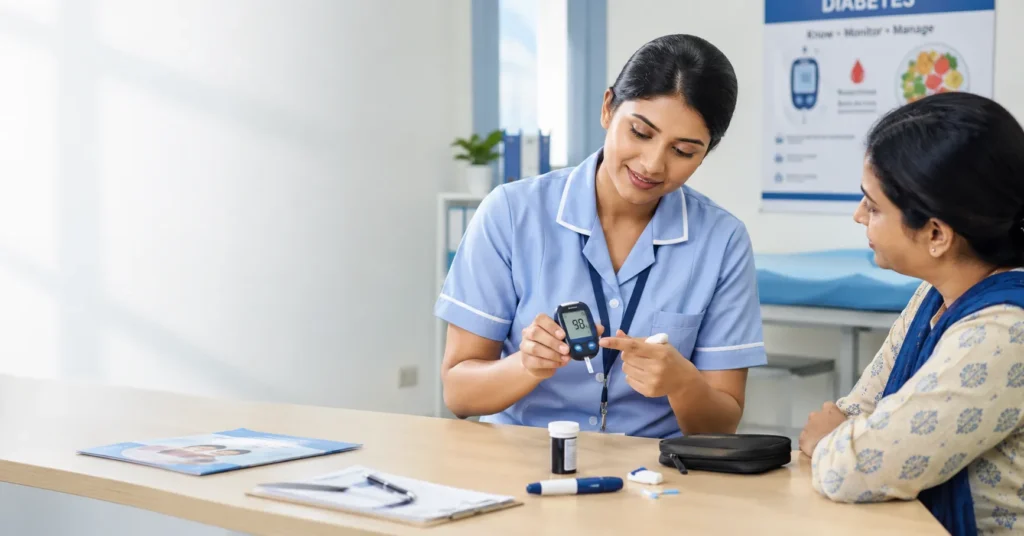
Diabetes care courses are structured education programmes that teach the practical, day-to-day skills of managing blood sugar. Internationally, this field is called diabetes self-management education and support (DSMES).
They come in two broad forms, and the difference matters:
| Type | Who it’s for | What it delivers |
|---|---|---|
| Patient education programmes | People with diabetes and their families | Self-monitoring, diet, insulin technique, complication prevention |
| Professional certification courses | Nurses, paramedics, dietitians, pharmacists | Clinical skills plus the ability to teach and counsel patients |
Both are called diabetes care courses in everyday use. This guide covers both, because they feed each other – patients only get good education when someone has been trained to deliver it.
If you are comparing formats, our complete list of healthcare courses shows how certification programmes sit alongside longer diploma and degree routes.
The Daily Problems Diabetes Care Courses Are Built to Solve
1. Readings without meaning
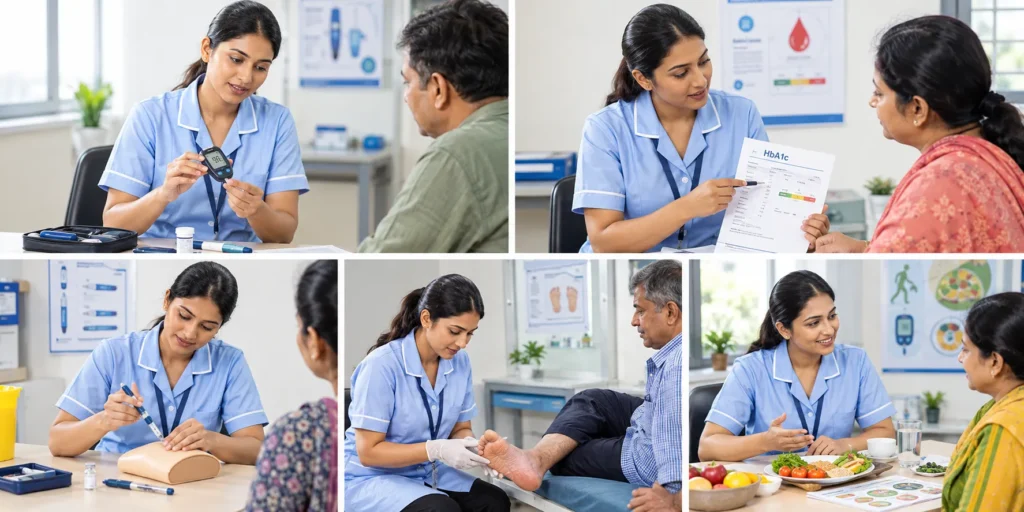
Most patients are handed a glucometer and shown which button to press. Nobody explains why the number was 180 mg/dL after lunch but 110 mg/dL after dinner. Without pattern recognition, readings become anxiety instead of information.
2. Medicine and insulin confusion
Multiple tablets, different timings, an insulin pen with a specific storage rule, and side effects nobody warned them about. Doses get skipped. Diabetes care courses replace that confusion with a simple, repeatable routine.
3. Food guesswork
“Avoid sugar” is not a diet plan. Indian meals are carbohydrate-heavy by design – roti, rice, poha, idli, dal-chawal. Patients need portion logic that works with real family cooking, not a printed diet chart from 2011.
4. Emotional burnout
Diabetes distress is real and under-treated. Guilt after eating a sweet at a wedding, fear of complications, exhaustion from a condition that never takes a day off.
The 2026 ADA Standards specifically call for behavioural and psychosocial support inside education programmes, not as an afterthought – which is why counselling skills form a full module in our diabetes care professional course.
What Diabetes Care Courses Actually Teach
Disease education in plain language
How glucose moves through the body, what insulin resistance means, what actually happens during a spike, and which early warning signs of neuropathy, retinopathy, or nephropathy deserve a same-week appointment.
Good diabetes care courses also dismantle myths – that insulin means “the end stage,” that diabetes is caused by eating sweets, that a “sugar-free” biscuit is a free food.
Monitoring skills that go beyond button-pressing
| Monitoring method | Typical frequency | What it tells you |
|---|---|---|
| Fingerstick glucose testing | 1–4 times daily | Immediate feedback on food and dose |
| Continuous glucose monitor (CGM) | 24/7 | Trends, overnight lows, time-in-range |
| HbA1c test | Every 3–6 months | Average control over ~3 months |
| Blood pressure | Weekly | Cardiovascular and kidney risk |
| Foot inspection | Daily | Early ulcer prevention |
| Dilated eye exam | Annually | Retinopathy screening |
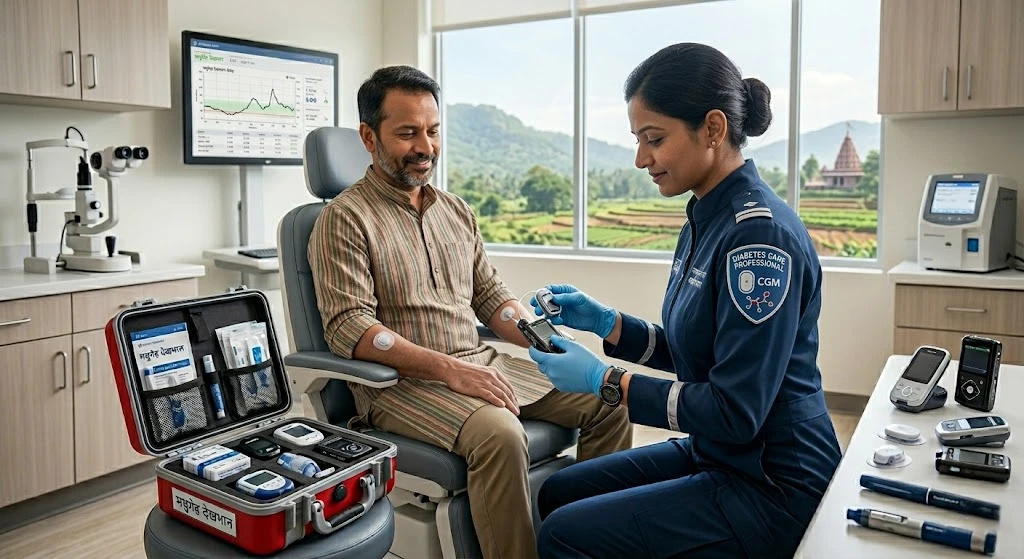
CGM has become a major part of modern diabetes care courses. Reading a trend arrow, understanding time-in-range, and reacting to a falling curve before a hypo happens are skills that simply did not exist in older curricula.
Indian meal planning that families will actually follow
Carbohydrate counting using real packet labels. Portion estimation without a weighing scale. Swapping refined flour for millets and whole grains. Handling a wedding buffet, a fast, or a festival without panic.
This is where diabetes care courses overlap heavily with clinical nutrition training – and why many institutes teach the two together. Our roundup of clinical nutrition courses in Gurgaon explains how the two specialisations combine.
Safe, realistic exercise
Not “walk 45 minutes daily.” Instead: when to check sugar before activity, how to prevent exercise-induced hypoglycaemia, what to do about knee pain, and how resistance training improves insulin sensitivity.
The 2026 ADA Standards recommend an obesity treatment plan aiming for at least 5–7% weight loss where relevant – a target diabetes care courses translate into weekly, achievable steps.
Emotional coping and family communication
Stress hormones raise blood glucose directly. Programmes teach mindfulness basics, problem-solving, how to ask family for support without conflict, and how to recover from a bad week instead of abandoning the plan entirely.
The Evidence: What Actually Improves
This is where diabetes care courses stop being a feel-good idea and start being measurable medicine.
| Outcome | What research shows |
|---|---|
| HbA1c | A meta-analysis of 44 studies across 21 low- and middle-income countries found structured diabetes self-management education reduced HbA1c by 0.64% in randomised trials versus standard care (PubMed Central) |
| Emergency visits | Structured DSMES is associated with fewer emergency department visits and hospitalisations |
| Cardiometabolic risk | Improvements in blood pressure, lipids, and weight alongside glucose |
| Psychosocial wellbeing | Reduced diabetes distress and improved self-efficacy |
| Cost | The ADA notes DSMES improves outcomes and reduces costs, and recommends payer reimbursement |
A 0.64% HbA1c drop may sound small. It is not. That is comparable to adding a medication — achieved through teaching, with no side effects and no monthly drug cost.
The 2026 ADA Standards go further, recommending DSMES at diagnosis, annually, when treatment goals are missed, when complications develop, and at major life transitions. In other words: education is not a one-time class. (ADA Standards of Care in Diabetes—2026, Section 5)
What Transformation Looks Like in Practice
The patterns below are composite examples drawn from typical outcomes reported in diabetes education literature — not individual patient records.
The “high but stable” patient. A 52-year-old teacher with an HbA1c near 9% who was taking medicines correctly but eating a 200g rice portion twice a day.
After learning carbohydrate counting and plate-method portioning in a structured programme, her readings settled and her HbA1c moved into the 7s over two review cycles – with no new medication.
The frequent-emergency patient. A young man on insulin whose sugars swung between 60 and 300 mg/dL. Once he learned to match insulin timing to meals, recognise early hypo symptoms, and keep a fast-acting carbohydrate on hand, the emergency visits largely stopped.
The newly diagnosed, terrified patient. The most common transformation of all: someone who arrives convinced life is over and leaves with a routine, a meal plan, and the phone number of an educator. Fear becomes a system.
Benefits That Go Beyond Blood Sugar
- Confidence. Patients stop panicking at every unusual reading and start responding to it.
- Stronger family support. Once relatives understand the condition, they stop being well-meaning saboteurs at the dinner table.
- Better mental health. Knowledge reduces catastrophising. Sleep improves as night-time lows and frequent urination settle.
- Work and life goals return. Travel, promotions, studies, and hobbies come back into range.
- Lower lifetime cost. Preventing one foot ulcer, one dialysis start, or one laser eye procedure repays the cost of diabetes care courses many times over.
Diabetes Care Courses as a Career – For Nurses and Paramedical Students
Here is the part most students miss. India has roughly 100 million people with diabetes and nowhere near enough trained educators to teach them. That mismatch is a career.
Who can enrol in professional diabetes care courses:
- GNM and B.Sc Nursing graduates
- Final-year nursing students wanting an add-on qualification
- Working staff nurses seeking a specialisation
- Dietitians, pharmacists, and graduates of paramedical courses in allied roles
Where certified professionals work:
- Diabetes and endocrinology OPDs
- Diabetic foot and wound care clinics
- Corporate wellness and preventive health programmes
- Dialysis and nephrology support teams
- Home healthcare and chronic-care startups
- Insulin and CGM device companies (patient training roles)
- Telehealth and digital diabetes platforms
Because the ADA now explicitly recommends delivering DSMES via telehealth and digital platforms to widen access, remote diabetes educator roles are growing quickly — a genuinely flexible option for nurses.
If you are comparing specialisations, it is worth reading our guides on diabetes educator training updates for 2026 and high-salary diploma courses in the medical field.
Diabetes Care Professional Certification at Global A1 Institutes, Gurgaon
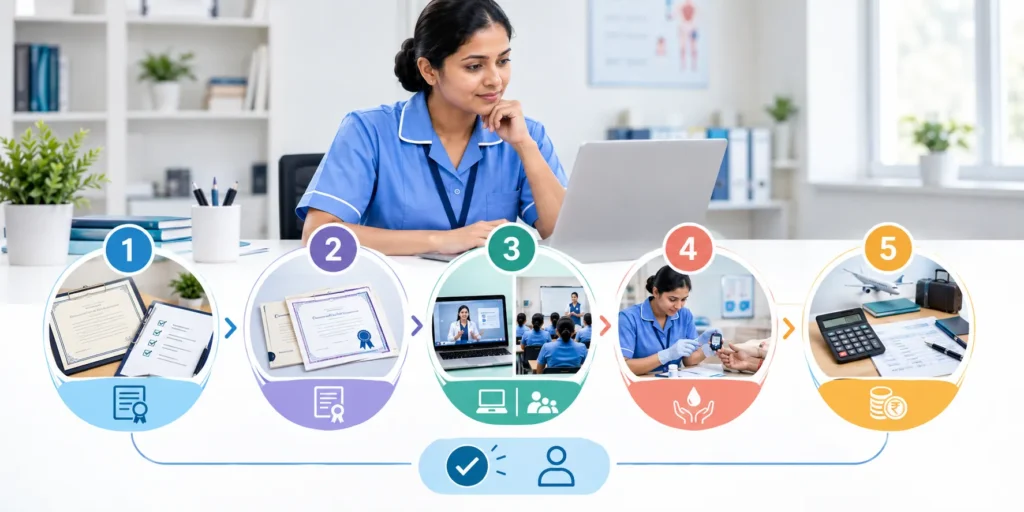
At Global A1 Institutes, Pataudi (Gurgaon, Haryana), our Diabetes Care Professional Certification is a 3-month, CPD-accredited programme built around one idea: a trained professional changes patient outcomes far more reliably than a pamphlet does.
What the course covers:
- Blood glucose monitoring, glucometer and CGM basics
- Insulin types, injection technique, storage, and dose timing
- Diet and lifestyle counselling adapted to Indian households
- Diabetic foot care, wound prevention, and complication screening
- Patient education and counselling skills — how to teach, not just treat
- Emergency management of hypoglycaemia and hyperglycaemia
Why students choose us:
- Real hospital training at Global Hospital & Trauma Centre — actual patients, actual protocols
- Practising doctors and senior nurses as faculty, not textbook-only instructors
- CPD accreditation aligned with international hiring frameworks
- Flexible batches for working nurses, including weekend options
- Placement support across Delhi-NCR and Haryana
We serve students from Gurugram, Pataudi, Rewari, Manesar, Dharuhera, Jhajjar, Bhiwadi, and South Delhi, with several learners travelling in from across Haryana and Rajasthan.
Explore all our nurse certification courses and paramedical courses, or talk to our admissions team for guidance on which programme fits your background.
How to Choose the Right Diabetes Care Course
- Check for hands-on clinical exposure. Theory-only diabetes care courses do not build confidence with a real patient.
- Confirm the accreditation. CPD accreditation matters for hospital hiring and international mobility.
- Look at the syllabus date. If CGM and current guidelines are missing, the curriculum is outdated.
- Ask who teaches. Practising clinicians beat career trainers.
- Ask about placement. A certificate without a job pathway is an expensive PDF.
- Match the duration to your life. A 3-month format lets working nurses upskill without pausing income — compare durations across all our certification and diploma courses before you decide.
Three Myths Worth Killing
“Education is optional once medicines start.” The opposite. The ADA recommends education at diagnosis and repeatedly afterwards, precisely because medication alone leaves most Indian patients above target.
“Only doctors can counsel diabetic patients.” Nurses and trained diabetes care professionals deliver most of the world’s DSMES. Doctors rarely have 45 minutes per patient. Educators do.
“It’s just a diet lecture.” Modern diabetes care courses cover insulin pharmacology, device technology, complication screening, and behavioural counselling. Diet is one module out of many.
The Bottom Line
India has more people with diabetes than most countries have people. Fewer than one in four treated patients reach target control. The missing ingredient is rarely medication — it is teaching.
That is what makes diabetes care courses genuinely transformative. For patients, they convert fear into a daily routine that works. For nurses and paramedical graduates, they open a specialisation with real demand, real flexibility, and real impact.
If you are living with diabetes, ask your doctor for a referral to a structured education programme. If you are a healthcare professional, this may be the most useful three months you invest in your career.
Enquire about the Diabetes Care Professional Certification →
Frequently Asked Questions
Do diabetes care courses really lower blood sugar?
Yes. Pooled trial evidence from low- and middle-income countries shows an average HbA1c reduction of about 0.64% versus standard care, alongside better blood pressure, weight, and psychological wellbeing.
Are diabetes care courses for patients or for professionals?
Both. Patient programmes teach self-management. Professional certifications, like the one at Global A1 Institutes, train nurses and paramedics to deliver that education clinically.
Who is eligible for a diabetes care professional certification in India?
Typically GNM or B.Sc Nursing graduates, final-year nursing students, and allied health graduates. Prior clinical experience helps but is not mandatory for most short-term programmes.
How long do diabetes care courses take?
Professional certifications commonly run 3 months. Patient education programmes are usually delivered over a few weeks of sessions plus ongoing follow-up.
Can I do a diabetes care course while working as a nurse?
Yes. Weekend and part-time batches exist specifically for working professionals.
Where can I do a diabetes care course near Gurgaon?
Global A1 Institutes runs its Diabetes Care Professional Certification from its Pataudi campus in Gurgaon, Haryana, with hospital-based training and flexible batch timings.
Is diabetes reversible after taking a course?
Type 2 diabetes can go into remission for some people through substantial, sustained weight loss and lifestyle change – but this is individual and must be medically supervised. Education makes it far more achievable; it does not guarantee it.
What is DSMES?
Diabetes self-management education and support – the international clinical term for structured diabetes education, carried an “A” grade recommendation in the ADA Standards of Care in Diabetes—2026.