In a cardiac emergency, every second counts – and as a nurse, you are often the first to recognise the difference between a patient who needs urgent assessment and one who needs immediate chest compressions.

Quick answer
In a cardiac emergency, a nurse’s first job is to tell a heart attack from a cardiac arrest. A heart attack patient is usually awake and breathing. A patient in cardiac arrest is unresponsive and not breathing normally (gasping does not count), so you call for help and start chest compressions at once: 100 to 120 per minute, at least 5 cm deep, with full chest recoil. Under the 2025 American Heart Association (AHA) Guidelines for CPR and Emergency Cardiovascular Care, IV access is now preferred over IO access, and temperature control continues for at least 36 hours in adults who stay unresponsive after the heart restarts.
Nurses are usually the first to notice when a patient is getting worse, and often the first person at the bedside when one collapses. Clinical skill is only part of the job. Clear communication, accurate documentation and a structured handover are just as much a part of good cardiac care.
This guide covers:
- How to tell a heart attack from a cardiac arrest
- What changed in the 2025 AHA guidelines
- Adult CPR numbers, shockable rhythms and cardiac arrest medicines
- Reversible causes and care after the heart restarts (ROSC)
- What nurses can do independently, what to document and how to hand over
If you are building a career in emergency or critical care, see the nursing and paramedical courses at Global A1 Institutes.
What is a cardiac emergency?
A cardiac emergency is any sudden heart problem that threatens life and needs immediate care. In clinical practice, nurses most often see four types:
- Acute coronary syndrome (ACS): blood flow to the heart muscle is suddenly reduced or blocked. This includes heart attack (myocardial infarction) and unstable angina.
- Cardiac arrest: the heart stops pumping blood effectively.
- Life-threatening arrhythmias: the heart beats too fast, too slowly or irregularly and cannot pump enough blood.
- Acute heart failure: the heart suddenly struggles to pump, and fluid can back up into the lungs.
These conditions overlap. A heart attack can trigger a dangerous rhythm, and that rhythm can cause a cardiac arrest.
Heart attack vs cardiac arrest | what is the difference?
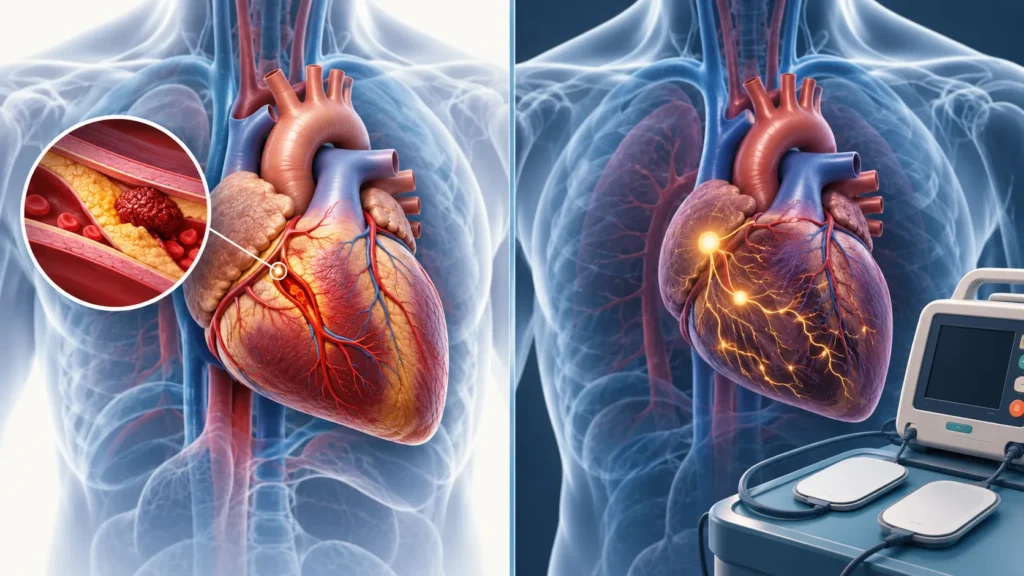
A heart attack is a circulation problem. A cardiac arrest is an electrical problem in which the heart stops pumping. This is the distinction that matters most at the bedside, and it is the one most often got wrong. The American Heart Association explains the difference the same way.
| Feature | Heart attack | Cardiac arrest |
|---|---|---|
| What has happened | Blood flow to part of the heart muscle is blocked | The heart has stopped pumping effectively |
| Is the patient awake? | Usually yes | No |
| Are they breathing? | Yes, though they may be breathless | No, or only gasping |
| Is there a pulse? | Yes | No definite pulse |
| Can they describe chest pain? | Usually yes | No, they cannot speak |
| What the nurse does | Assess, record a 12-lead ECG, give oxygen if needed, escalate | Call for help and start chest compressions now |
A heart attack can lead to cardiac arrest, but not every cardiac arrest is caused by a heart attack. Both statements matter. The first tells you to watch a patient with chest pain closely. The second tells you not to assume the cause when someone collapses.
Is gasping a sign of breathing?
No. Occasional gasping, called agonal breathing, is common in the first minutes of cardiac arrest. The 2025 AHA adult basic life support guideline notes that it is present in up to 40% to 60% of out-of-hospital arrests, and it is often mistaken for breathing.
If the patient is unresponsive and not breathing normally, treat it as cardiac arrest and start compressions.
What changed in the 2025 AHA CPR guidelines?
The American Heart Association published the 2025 Guidelines for CPR and Emergency Cardiovascular Care on 22 October 2025. These are the changes most relevant to nurses caring for adults:
- IV access comes before IO access. For adults in cardiac arrest, try a line into a vein (IV) first. A line into the bone (IO) is reasonable if IV attempts fail or are not feasible. Three large randomised trials in out-of-hospital cardiac arrest did not show IO access to be better. Never delay compressions or a needed shock to place a line.
- Double sequential and vector change defibrillation are not recommended. Using two defibrillators one after the other (double sequential external defibrillation, DSED), or moving the pads to a new position (vector change), has not been shown to help in VF that keeps returning. The AHA says neither is recommended until more research is done.
- Temperature control continues. If an adult’s heart restarts but they cannot follow spoken commands, keep their temperature at a chosen level between 32 °C and 37.5 °C for at least 36 hours, and prevent fever afterwards.
- A Universal Chain of Survival. One chain of survival now covers adults and children, in and out of hospital.
- Adult and child choking care is now the same. For adults and children, give alternating cycles of 5 back blows and 5 abdominal thrusts, starting with back blows.
- A new ethics chapter. It addresses current ethical challenges in resuscitation across all age groups.
- Head-up CPR is not recommended outside clinical trials.
You can read every recommendation in the 2025 AHA adult advanced life support guideline.
How do you spot early warning signs of cardiac arrest?
Most in-hospital cardiac arrests are not sudden. There is usually a window of hours in which the patient slowly gets worse.
Look for a patient who is drifting rather than crashing:
- A rising respiratory rate
- A heart rate that is climbing or falling
- Blood pressure trending down over several sets of observations
- Falling oxygen saturation
- Reduced urine output
- New confusion, drowsiness or agitation
- A patient who says something does not feel right
Respiratory rate is the most sensitive early sign and the observation most often estimated rather than counted. Always count it for a full minute.
Track-and-trigger tools such as the National Early Warning Score (NEWS2) from the Royal College of Physicians combine these observations into a score that tells you when to escalate.
My patient’s numbers are only slightly off, but something feels wrong. Should I escalate?
Yes. Clinical concern is a valid reason to escalate on its own, and most early warning systems include it for exactly this reason. You do not need a number to justify asking for a review. If you escalate and are wrong, it costs a phone call. If you stay silent and are right, it costs far more.
What are the key adult CPR numbers?
These targets come from the 2025 AHA adult basic life support guideline and the adult cardiac arrest algorithm.
| CPR measure | Recommended target |
|---|---|
| Compression rate | 100 to 120 per minute |
| Compression depth | At least 5 cm (2 inches), but not more than 6 cm (2.4 inches) |
| Chest recoil | Allow full recoil; do not lean on the chest between compressions |
| Ratio without an advanced airway | 30 compressions to 2 breaths |
| With an advanced airway | 1 breath every 6 seconds (10 per minute) with continuous compressions |
| Pulse check | No more than 10 seconds |
| Chest compression fraction | At least 60% of the resuscitation time |
| Changing compressors | About every 2 minutes (about 5 cycles), at the rhythm check |
| End-tidal CO₂ (ETCO₂) | If low or falling, reassess compression quality |
The ETCO₂ line is the one most often skipped. Waveform capnography does more than confirm tube placement. A low or falling ETCO₂ during CPR is a prompt to check the rate, depth and recoil of compressions.
A sudden rise may be the first sign that circulation has returned. Ventilation, medicines and the cause of the arrest can also change the reading, so do not use a single ETCO₂ value on its own to decide when to stop resuscitation.
How long should I check for a pulse?
No more than 10 seconds. If you are not sure you can feel a pulse, treat it as no pulse and continue compressions. Uncertainty is not a reason to pause.
Which cardiac arrest rhythms are shockable?
VF and pulseless VT are shockable. Asystole and PEA are not. Every cardiac arrest rhythm belongs to one of these two groups, and the group decides the treatment.

| Group | Rhythms | Shock? |
|---|---|---|
| Shockable | Ventricular fibrillation (VF) and pulseless ventricular tachycardia (pVT) | Yes |
| Non-shockable | Asystole and pulseless electrical activity (PEA) | No |
Neither asystole nor PEA is ever shocked. For both, the work is high-quality compressions, adrenaline and finding the cause.
PEA deserves a moment. The monitor shows organised electrical activity, but there is no pulse. The rhythm on the screen looks survivable, yet the patient is in cardiac arrest. Trust the pulse, not the screen.
The monitor shows a rhythm. Why are we still doing compressions?
Because a rhythm on a monitor shows electrical activity, not a pumping heart. That is exactly what PEA is. The decision to compress depends on the patient, not the display.
Which medicines are used in adult cardiac arrest, and when?
These doses are from the 2025 AHA adult cardiac arrest algorithm:
- Adrenaline (epinephrine) 1 mg IV/IO every 3 to 5 minutes. In non-shockable rhythms (asystole or PEA), give it as soon as feasible. In shockable rhythms (VF or pVT), give it after the first defibrillation attempts have failed.
- Amiodarone 300 mg as the first dose, then 150 mg, for VF or pVT that does not respond to shocks.
- Lidocaine 1 to 1.5 mg/kg as the first dose, then 0.5 to 0.75 mg/kg, as an alternative to amiodarone.
These are the algorithm’s figures, not permission to act on your own. The section on what nurses can do independently, below, matters more than the numbers.
What reversible causes can lead to cardiac arrest?
While the resuscitation continues, someone in the team should work through the reversible causes, known as the H’s and T’s:
| The 5 H’s | The 5 T’s |
|---|---|
| Hypovolaemia | Tension pneumothorax |
| Hypoxia | Tamponade (cardiac) |
| Hydrogen ion (acidosis) | Toxins |
| Hypo- or hyperkalaemia | Thrombosis (pulmonary) |
| Hypothermia | Thrombosis (coronary) |
In a non-shockable arrest, the answer is often on this list. Compressions and adrenaline buy time. Finding and treating the cause is what ends the arrest.
What happens after the heart restarts (ROSC)?
Return of spontaneous circulation (ROSC) is not the end of the emergency. It is the start of a different one. The 2025 AHA post-cardiac arrest care guideline recommends:
- Oxygen: give 100% oxygen until saturation can be measured reliably, then adjust to keep SpO₂ at 90% to 98%.
- Blood pressure: avoid low blood pressure and keep the mean arterial pressure (MAP) at 65 mmHg or higher.
- 12-lead ECG as soon as possible, to look for a coronary cause.
- Neurological checks: assess level of consciousness and responses.
- Temperature control: in adults who stay unresponsive, keep the temperature between 32 °C and 37.5 °C for at least 36 hours, and prevent fever.
- Treat the cause of the arrest.
Decisions about the patient’s likely neurological outcome are generally delayed until at least 72 hours after normal temperature returns and sedation stops.
The patient has ROSC and looks stable. Can I step back?
Not yet. The first hours after ROSC carry a real risk of re-arrest and sudden drops in blood pressure. This period calls for closer observation, not less.
What can nurses do independently during a cardiac arrest?
For a nurse, knowing what you can do independently and what needs an order is essential. It depends on three things:
- What your nursing registration and local regulations allow
- Your employer’s policies and standing orders (written instructions approved in advance for specific situations)
- Your current training and assessed competence
Actions nurses can usually take, depending on those rules: recognising deterioration and calling for help, starting chest compressions, attaching a defibrillator or AED and delivering a shock when trained and authorised, giving oxygen, recording a 12-lead ECG, taking blood samples where allowed, and keeping the resuscitation record.
Actions that usually need specific authorisation, an order or an approved protocol: giving medicines during cardiac arrest, placing advanced airways and deciding when to stop resuscitation. An order alone does not allow you to perform a task outside your permitted role or competence.
Two things follow from this. First, learn your hospital’s standing orders before an emergency; the middle of a cardiac arrest is not the time to find out.
Second, a course certificate is not the same as permission to perform a procedure. Training teaches you how to do a skill. Whether you may use it depends on your registration, your competence and your employer’s policies.
I hold an ACLS certificate. Does that mean I can give adrenaline?
Not on its own. An Advanced Cardiovascular Life Support (ACLS) certificate shows you have completed the training. Permission to give adrenaline depends on your nursing role and the approved orders or protocols in your workplace. Check your local policy.
What must nurses document during a cardiac arrest?
Documentation is part of emergency care, not paperwork for afterwards. Record:
- The time the patient was found, and their condition
- The time chest compressions started
- The time of the first shock and every shock after it, with the energy used
- Every medicine: name, dose, route, time, who gave it, and the order or protocol followed
- The heart rhythm at each check
- The time circulation returned (ROSC), or the time CPR stopped and who made that decision
- Who was present
Follow your hospital’s resuscitation record form for any other required details. Times are easily lost in an emergency, so give one team member the job of recording events as they happen.
How do you hand over a patient after cardiac arrest?
Use the structured format your unit follows, such as SBAR (Situation, Background, Assessment, Recommendation) from the Institute for Healthcare Improvement:
- Situation: what happened and when.
- Background: relevant medical history and the reason for admission.
- Assessment: current vital signs, heart rhythm, ECG findings and treatment given.
- Recommendation: what care is needed next and what changes to watch for.
State clearly when the patient collapsed or was found, when CPR started and when circulation returned. If any time is unknown or estimated, say so.
There was no time to write anything during the arrest. What now?
Write the record as soon as urgent care allows. Mark it clearly as a late entry, record the date and time you are writing it, and add the event times you know. Follow your hospital’s documentation policy.

Never guess missing details or make a late entry look as though it was written during the event.
Key takeaways
- A patient in cardiac arrest is unresponsive and not breathing normally. They cannot report chest pain.
- Gasping is not breathing. Treat it as cardiac arrest.
- The 2025 AHA guidelines (22 October 2025) prefer IV over IO access, do not recommend double sequential or vector change defibrillation, and keep temperature control for at least 36 hours in unresponsive adults.
- Compressions: 100 to 120 per minute, 5 to 6 cm deep, full recoil. 30:2 without an advanced airway; 1 breath every 6 seconds with one.
- A low or falling ETCO₂ during CPR means: check compression quality.
- Shockable: VF and pVT. Non-shockable: asystole and PEA. Asystole is never shocked.
- Adrenaline 1 mg every 3 to 5 minutes: as soon as feasible in non-shockable rhythms, after failed shocks in shockable ones.
- After ROSC: SpO₂ 90% to 98%, MAP at least 65 mmHg, 12-lead ECG, temperature control.
- A certificate is not authorisation. Your scope comes from your registration and your employer’s protocols.
- Record the times: found, compressions started, each shock, each drug, ROSC.
Conclusion
Good cardiac emergency care starts before the arrest: spotting warning signs early, calling for help quickly and responding in the right order.
When an arrest does happen, high-quality compressions, early defibrillation for shockable rhythms and a methodical search for reversible causes give the patient the best chance. Clear communication, accurate documentation and a structured handover complete the job.
Guidelines change, and skills fade without practice. Review the latest recommendations, practise regularly between certificate renewals, and know exactly what you are trained and authorised to do in your workplace.
To build those skills with hands-on training, explore the courses at Global A1 Institutes, read our guide to the best emergency medical technician courses, or contact our team for advice on the right programme.
FAQs about cardiac emergency care for nurses
Q. What is the difference between a heart attack and a cardiac arrest?
A heart attack happens when blood flow to part of the heart is blocked; the person is usually awake and may have chest pain. A cardiac arrest happens when the heart stops pumping effectively; the person is unresponsive and not breathing normally. A heart attack can cause cardiac arrest, but cardiac arrest has other causes too.
Q. Which heart rhythms need a shock?
Ventricular fibrillation (VF) and pulseless ventricular tachycardia (pVT) need a shock. Asystole (no electrical activity) and pulseless electrical activity (PEA, electrical activity without a pulse) do not. They need CPR, adrenaline and treatment of the cause.
Q. How fast and how deep should adult chest compressions be?
Give 100 to 120 compressions per minute, at least 5 cm (2 inches) deep but not more than 6 cm (2.4 inches), and let the chest rise fully after each compression.
Q. What changed in the 2025 AHA CPR guidelines?
The main adult changes are: IV access is preferred over IO access in cardiac arrest; double sequential and vector change defibrillation are not recommended; temperature control continues for at least 36 hours in adults who stay unresponsive after ROSC; one Universal Chain of Survival now covers all ages and settings; and adult choking is treated with alternating 5 back blows and 5 abdominal thrusts.
Q. When should adrenaline be given in cardiac arrest?
Adrenaline 1 mg is given every 3 to 5 minutes. In asystole or PEA, give the first dose as soon as feasible. In VF or pVT, give it after the first defibrillation attempts have failed.
Q. Can a nurse give adrenaline during cardiac arrest?
It depends on local nursing regulations, your hospital’s approved orders and protocols, and your training and competence. A certificate alone does not give permission, so learn your workplace rules before an emergency.
Q. What should nurses record during CPR?
Record when the patient was found and when CPR started, the time of every shock, the rhythm at each check, every medicine (name, dose, route, time, who gave it and under which order or protocol), the time of ROSC or when CPR stopped and who decided, and who was present.
Q. What does ETCO₂ tell you during CPR?
End-tidal carbon dioxide (ETCO₂) is the amount of carbon dioxide at the end of a breath out. During CPR it reflects how well blood is moving. A low or falling reading means you should check compression rate, depth and recoil; a sudden rise may signal ROSC. Ventilation, medicines and the cause of the arrest can also affect it.
Q. What blood pressure and oxygen targets apply after ROSC?
The 2025 AHA guideline recommends keeping the mean arterial pressure at 65 mmHg or higher and adjusting oxygen to keep SpO₂ between 90% and 98% once it can be measured reliably.
References
- American Heart Association. 2025 AHA Guidelines for CPR and ECC: Top Things to Know.
- American Heart Association. Adult Basic Life Support (2025).
- American Heart Association. Adult Advanced Life Support (2025).
- American Heart Association. Post-Cardiac Arrest Care (2025).
- American Heart Association. CPR and ECC Algorithms.
- American Heart Association. Heart Attack or Sudden Cardiac Arrest: How Are They Different?
- Royal College of Physicians. National Early Warning Score (NEWS) 2.
- Institute for Healthcare Improvement. SBAR Tool: Situation-Background-Assessment-Recommendation.