India’s emergency care system changed a lot between 2025 and 2026. A new disaster law came into force. A nationwide cashless treatment scheme for road accident victims started. And for the first time, paramedical staff have a real national register they must enrol in.
If you work in a hospital emergency department, drive with an ambulance team, or plan to join this field, the rules you trained under have quietly moved.
This guide explains what an emergency management course in India covers today, which skills hospitals now test you on, what you can earn, and how to pick a programme that is actually recognised.
Who this guide is for: nurses, ward staff, EMTs, ambulance crew, hospital administrators, fresh 10+2 students exploring paramedical careers, and anyone preparing for a role in trauma or critical care.
What Changed in India’s Emergency Management (2025-2026)
Most online articles on this topic still describe American systems. That information will not help you pass an Indian hospital interview. Here is what actually applies in India right now.
1. The Disaster Management (Amendment) Act, 2025
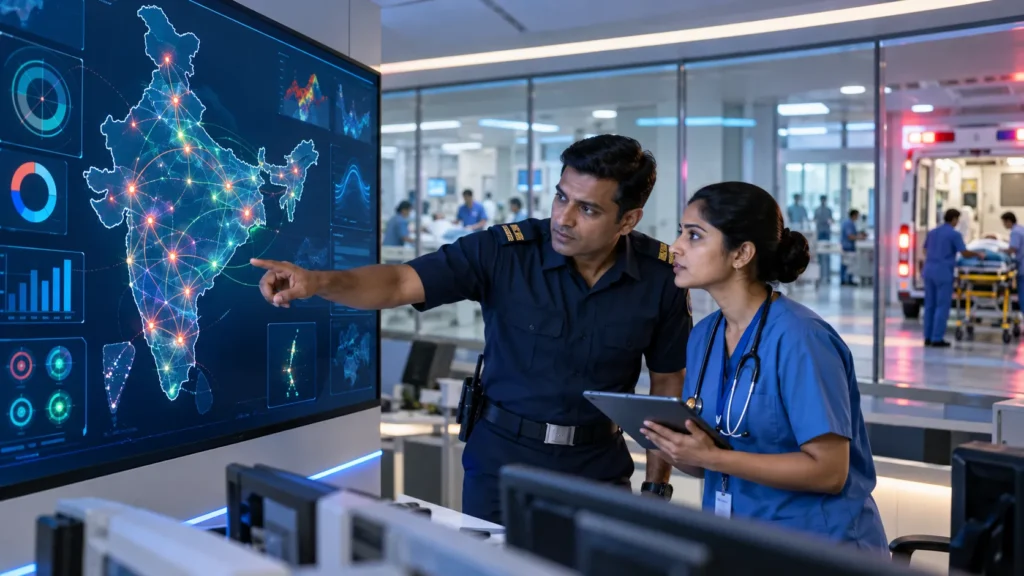
The Disaster Management Act, 2005 was amended in 2025. The President gave assent on 29 March 2025, and the changes took effect from 9 April 2025.
Four points matter for healthcare staff:
- Urban Disaster Management Authorities (UDMAs) can now be set up in state capitals and cities with municipal corporations. City-specific risks like urban flooding and heatwaves finally get their own plans.
- A national disaster database is now mandatory. It holds risk assessments, mitigation plans and live disaster data.
- The National Crisis Management Committee and the High-Level Committee received formal statutory status.
- NDMA and State Authorities now prepare disaster plans directly, instead of routing them through Executive Committees.
You can read the amendment on the NDMA official website or the Press Information Bureau summary.
For a hospital, this means your hospital disaster management plan is no longer a file kept in a cupboard for the accreditation visit. It has to match the district and city plan, and it has to be tested.
2. Cashless Treatment for Road Accident Victims
The Ministry of Road Transport and Highways notified the Cashless Treatment of Road Accident Victims Scheme in 2025.
Any road accident victim in India can receive cashless treatment of up to ₹1.5 lakh for seven days at hospitals empanelled under Ayushman Bharat PM-JAY.
The National Health Authority runs it, using the eDAR accident-reporting app linked to its Transaction Management System. For hit-and-run deaths, families receive ₹2 lakh.
Why this matters to you: hospitals now need trained staff who can register a trauma case, raise pre-authorisation immediately, and document the timeline correctly. Emergency care has become a documentation skill as much as a clinical one.
The scheme exists because of the numbers. The Road Accidents in India 2024 report from MoRTH recorded over 1.77 lakh deaths – roughly 485 people every day.
About 66% of victims were between 18 and 45 years old. Over-speeding was linked to around 70% of deaths, and more than 54,000 people died because they were not wearing a helmet. You can download the full report from the MoRTH website.
3. NCAHP Registration Is Now Real
The National Commission for Allied and Healthcare Professions (NCAHP) Act, 2021 covers 56 recognised professional categories across 10 broad groups. Emergency and trauma care technology sits inside this framework.
Two things happened recently:
- NCAHP has issued standardised, competency-based curricula and asked institutions to adopt them from the 2026–27 academic session.
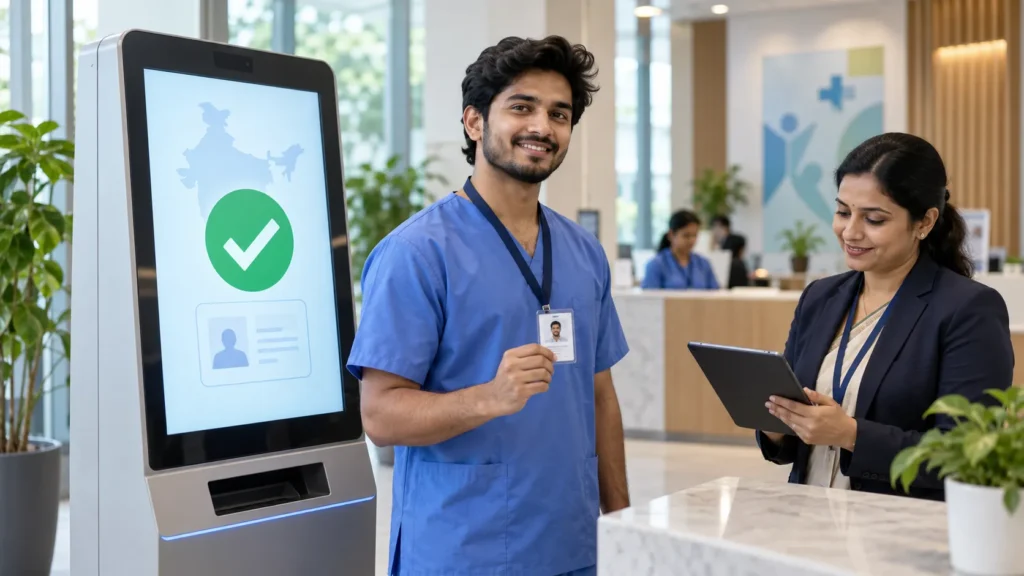
- A central register of allied and healthcare professionals is being built, linked to the Ayushman Bharat Digital Mission. Enrolment is a two-step process: the national Central Register plus your State Allied and Healthcare Council.
Reports also indicate NEET UG will become mandatory for certain allied and healthcare undergraduate courses from the 2027–28 session. Rules here are still settling, so check the NCAHP portal before you apply anywhere.
The practical takeaway: choose a course that follows NCAHP-aligned curriculum. An unrecognised certificate is becoming a dead end.
4. Climate and Urban Emergencies Are Now Routine
Heatwaves, flash floods in cities, building fires and pollution spikes are no longer rare events in North India. Delhi NCR sees all four. Emergency teams here handle heat stroke cases in May and respiratory crises in November as predictably as they handle road trauma all year.
Modern disaster preparedness training now includes surge planning for these seasonal patterns, not just earthquake drills.
What an Emergency Management Course Actually Teaches
A good programme mixes bedside clinical skill with systems thinking. Here is the honest breakdown.
Core Clinical and Pre-Hospital Skills
This is the part that saves the patient in front of you.
- Basic Life Support (BLS) and CPR, including correct compression depth and rate, and safe use of an AED
- Patient assessment – primary and secondary survey, checking airway, breathing and circulation in order
- Triage – sorting patients by how urgently they need care, not by who arrived first
- Bleeding control, splinting and spinal immobilisation for trauma cases
- Airway management and oxygen therapy
- Patient stabilisation and safe transfer during ambulance movement
- Recognising a stroke, heart attack or diabetic emergency early enough to matter
The idea behind all of it is the golden hour — the first hour after serious injury, when the right care makes the biggest difference to survival.
Hospital and Disaster Systems
This is the part that gets you promoted.
- Writing and testing a hospital disaster management plan
- Mass casualty incident (MCI) handling — what happens when 30 patients arrive in 20 minutes
- Hospital Incident Response System (HIRS) roles, so everyone knows who commands what
- Surge capacity planning — extra beds, oxygen supply, staff call-back lists
- Fire safety and evacuation drills, including how to move non-ambulatory patients
- NABH accreditation requirements for emergency preparedness and staff training
- Mock drills and after-action reviews — practising, then honestly recording what went wrong
NDMA publishes free Hospital Safety Guidelines that every hospital administrator should read at least once.
Communication Under Pressure
Poor communication kills more people in a crisis than poor clinical skill does.
- Using the 112 emergency helpline and 108 ambulance service correctly
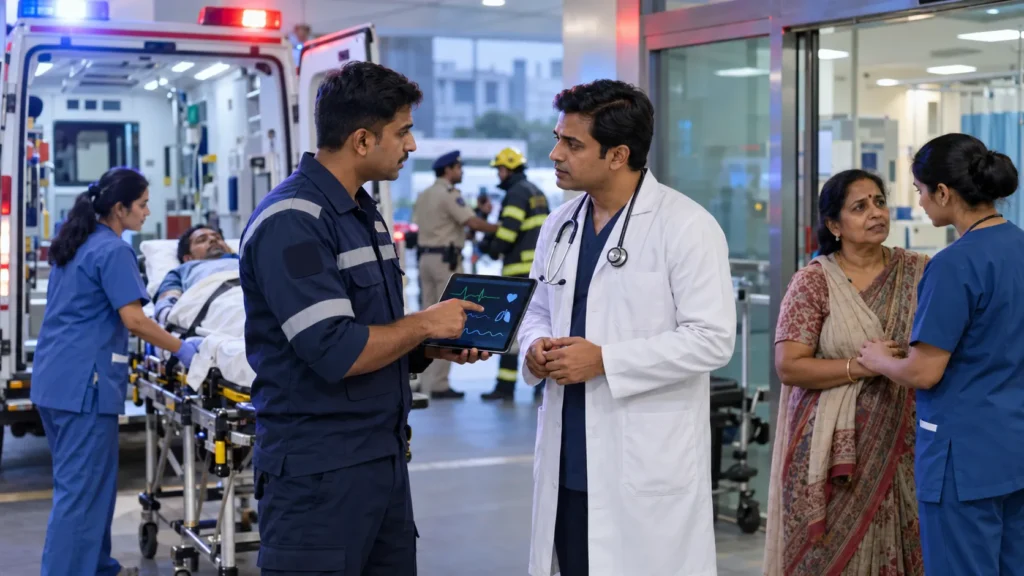
- Clean handover between ambulance crew and emergency department
- Speaking calmly to frightened families
- Coordinating with police, fire services, NDRF and SDRF teams
- Handling the media without speculating, and correcting misinformation fast
Who Should Take This Course?
| Your situation | What suits you best |
|---|---|
| 10+2 (PCB) student starting out | A full Emergency Medical Technician programme |
| Working nurse wanting emergency skills | A short first aid and emergency management certification |
| Ward or ICU nurse aiming at critical care | Critical care nursing with emergency add-ons |
| Hospital admin or quality staff | Disaster planning, NABH and audit-focused training |
| Fire, security or industrial safety officer | BLS plus mass casualty and evacuation modules |
If you are still deciding between healthcare career paths, our guide to the top high-salary diploma courses in the medical field compares options side by side.
Career Scope and Salary in India
Emergency-trained staff work in more places than most students expect:
- Hospital emergency departments and trauma centres
- Ambulance services, including the 108 network and private providers
- Corporate and industrial medical rooms
- Airports, metro networks, malls and large event venues
- Disaster response teams and NGOs
- Air ambulance and patient transfer services
What You Can Earn
Salary depends heavily on city, employer type and shift pattern. Treat these as indicative ranges, not promises.
| Stage | Typical monthly range |
|---|---|
| Fresh EMT / emergency technician | ₹15,000 – ₹30,000 |
| 3–5 years’ experience | ₹30,000 – ₹50,000 |
| Emergency supervisor / trainer | ₹50,000+ |
Job-posting data on Indeed India put the average emergency medical technician salary at roughly ₹21,700 per month as of early 2026, with most postings falling between about ₹15,900 and ₹29,700.
The stronger earnings usually come from stacking qualifications. An EMT who adds critical care or cardiac skills moves up faster than one who stays still. Our cardiac care nurse certification and critical care nurse course are common next steps.
Nurses moving toward leadership should also look at the skills required in nursing administration.
How to Choose the Right Course
Ask these seven questions before you pay any fee.
- Is the curriculum NCAHP-aligned? This decides whether your qualification is recognised later.
- How many hours are hands-on? Emergency skill is muscle memory. Slides do not build it.
- Is there real hospital exposure? Training inside a working hospital beats a classroom mannequin.
- Who teaches it? Practising doctors and emergency nurses, or full-time lecturers?
- Are mock drills included? Ask specifically about mass casualty and fire evacuation drills.
- Does it cover documentation? Cashless scheme paperwork and eDAR reporting are now part of the job.
- What placement support exists? Ask for the names of hospitals where past students were placed.
If a counsellor cannot answer question 1 or 3 clearly, keep looking.
Emergency Management Training in Gurugram and Delhi NCR
Delhi NCR is one of the busiest emergency care corridors in India. The region combines heavy expressway traffic on NH-48 and the Dwarka Expressway, dense industrial belts in Manesar and Bhiwadi, large residential high-rises, and severe seasonal heat and air pollution.
That mix creates steady demand for trained emergency staff across Gurugram, Faridabad, Delhi, Noida and Rewari.
At Global A1 Institutes, training runs from our academic campus in Pataudi, Gurgaon, next to Global Hospital & Trauma Centre — so students see real emergency cases rather than only simulations.
Relevant programmes include:
- Emergency Medical Technician (EMT) Course – full pre-hospital and trauma care training
- Advance First Aid & Emergency Management Course – 3 months, covering first aid, triage, BLS and patient stabilisation
- Critical Care Nurse Course – ICU management, life support and hemodynamic monitoring
- Quality Control Nurse Course – patient safety protocols and NABH/JCI frameworks
You can browse everything on our paramedical courses and nurse certification courses pages.
Start Where You Are
Emergency care in India is being formalised – new law, new register, new funding routes, new documentation. That is good news for anyone with proper training, and bad news for anyone relying on an unrecognised certificate.
You do not need to fix everything at once. Pick the single gap that would slow you down most in a real emergency. For many people that is BLS confidence. For others it is triage under pressure, or knowing the hospital plan well enough to lead when a senior is unavailable.
Then close that gap.
Ready to begin? Talk to our counsellors for the current batch schedule, fee structure and syllabus.
Paramedical courses: +91-9253601701 Certification courses: +91-9253601702
Frequently Asked Questions
Q. What is an emergency management course?
It is a training programme that teaches you to handle medical emergencies and disasters — from stabilising a single accident victim to running a hospital’s response when many casualties arrive at once. It combines clinical skills like BLS and triage with planning skills like drills, incident command and documentation.
Q. Who is eligible for an emergency management course in India?
For a full Emergency Medical Technician programme, most institutes ask for 10+2, usually with Physics, Chemistry and Biology, and a minimum age of 17. Short certification courses in first aid and emergency management are open to working nurses, ward staff and other healthcare workers. Rules are tightening under NCAHP, so confirm current eligibility with the institute before applying.
Q. How long does an emergency management course take?
Short certification courses typically run for around three months. Full EMT diploma or degree programmes run longer and include structured clinical rotations. The right length depends on whether you are adding a skill or starting a career.
Q. What is the salary of an emergency medical technician in India?
Job-posting data from early 2026 suggests an average of around ₹21,700 per month, with most listings between roughly ₹15,900 and ₹29,700. Experienced EMTs and supervisors earn more, especially in metro cities and private hospital chains.
Q. Is registration mandatory to work as an emergency care professional?
Under the NCAHP Act, 2021, allied and healthcare professionals are being brought onto central and state registers, and the Act restricts practice without registration. Implementation is still rolling out across states, so check the NCAHP portal and your state council for current requirements.
Q. What is the golden hour in emergency care?
The golden hour is the first hour after a serious injury. Care given in this window has the greatest effect on whether a patient survives. It is the reason India’s cashless treatment scheme and 108 ambulance network focus so heavily on reducing the time between an accident and hospital arrival.
Q. Can I take an emergency management course while working full time?
Yes. Many short certification courses are structured for working professionals, with schedules that fit around hospital shifts. Ask the institute directly about batch timings before enrolling.