
Quick Answer
An operation theatre technician salary in India is roughly ₹14,000 to ₹25,000 per month for freshers and ₹40,000 to ₹70,000 per month after 5–8 years of experience.
In annual terms, most OT technicians earn between ₹2 lakh and ₹7.2 lakh per year, while senior technicians in corporate hospitals, cardiac theatres or Gulf countries can cross ₹10-12 lakh per year.
Three things move your pay the most: your qualification (B.Sc. OTT earns 20–30% more than a short certificate), your specialisation (cardiac, neuro and robotic surgery pay a premium), and your employer (a central government post or a corporate chain pays far more than a small nursing home).
Who Is an Operation Theatre Technician?
An Operation Theatre (OT) Technician is a trained allied health professional who keeps the surgical theatre safe, sterile and ready. Surgeons get the credit, but no surgery starts until the OT technician says the theatre is ready.
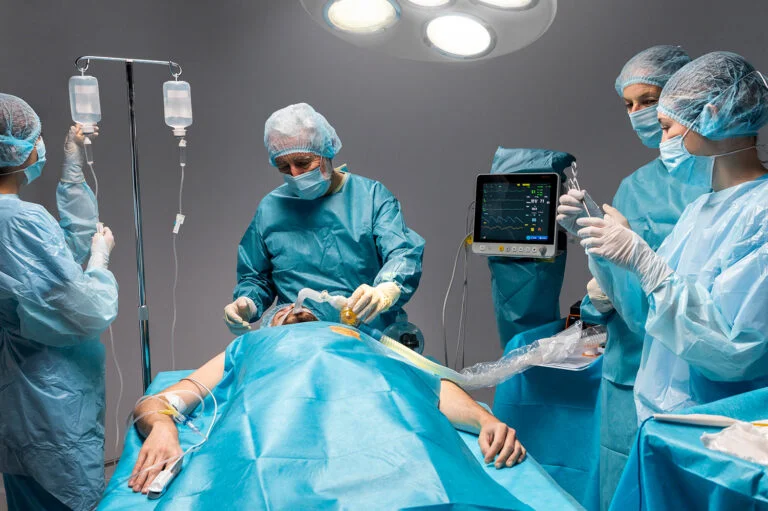
A normal working day looks like this:
- Before surgery: Setting up the OT, checking suction, cautery, lights and the anaesthesia machine, laying out sterile instrument trays as per the surgeon’s preference card.
- During surgery: Scrubbing in, passing instruments, counting sponges and needles, maintaining the sterile field, and supporting the anaesthetist.
- After surgery: Instrument decontamination, autoclave and CSSD cycles, biomedical waste segregation, and turning the theatre around for the next case.
- Always: Following infection-control and patient-safety protocols, and maintaining OT registers and consumable stock.
This is a regulated allied health profession in India. Operation Theatre Technology falls under the National Commission for Allied and Healthcare Professions (NCAHP), set up under the NCAHP Act, 2021 by the Ministry of Health & Family Welfare.
From the 2026–27 academic session, NCAHP has asked institutions to adopt its standard curricula for allied health programmes – which is exactly why hospitals now pay more for candidates from recognised, curriculum-aligned institutes.
If the surgical side interests you, also look at the closely related Anesthesia Technician course, since many hospitals hire both roles from the same talent pool.
Operation Theatre Technician Salary in India 2026 (By Experience)
Here is the realistic 2026 picture, based on hospital job postings, salary aggregator data and placement feedback. These are in-hand monthly figures for private hospitals, before overtime and night-duty allowances.
| Experience Level | Monthly Salary (₹) | Annual Salary (₹) | Typical Role |
|---|---|---|---|
| Fresher (0–2 years) | 14,000 – 25,000 | 1.7 – 3.0 LPA | Trainee / Junior OT Technician |
| Early career (2–5 years) | 25,000 – 38,000 | 3.0 – 4.6 LPA | OT Technician (scrub certified) |
| Mid-level (5–10 years) | 38,000 – 60,000 | 4.6 – 7.2 LPA | Senior OT Technician / Specialty scrub |
| Senior (10+ years) | 60,000 – 1,00,000+ | 7.2 – 12 LPA | OT In-charge / OT Supervisor |
Reality check for freshers: many hospitals start you on a 3-6 month training stipend of ₹8,000–₹15,000 before confirming you on the regular scale. This is normal.
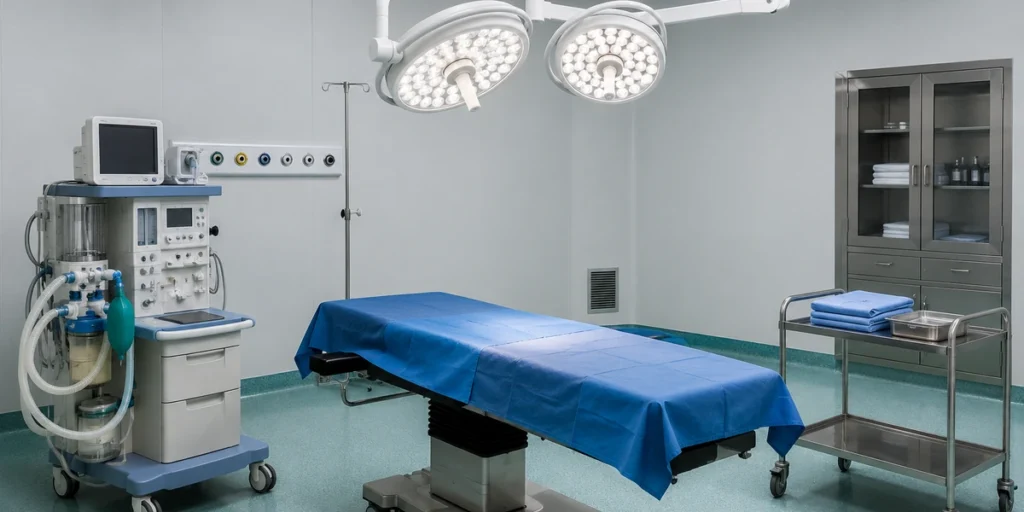
What matters is the hospital’s case load – a fresher who scrubs for 300 varied surgeries in year one will out-earn a fresher who scrubs for 60, within two years.
Why Salary Figures for This Job Vary So Much Online
If you search for OT technician pay, you will see everything from ₹22,000 a year to ₹8 lakh a year. Both are technically “real” numbers. Here is why:
- Small sample sizes. Aggregator sites sometimes build a city average from one or two self-reported entries.
- CTC vs in-hand. A ₹3.6 LPA “package” may be ₹24,000 in hand after PF and ESI deductions.
- Job title confusion. “OT Assistant”, “OT Attendant”, “Scrub Technician”, “Anaesthesia Technician” and “OT Technologist” are different pay grades but get mixed into one average.
- Tier mixing. A district nursing home in Bihar and a robotic surgery unit in Mumbai are in the same dataset.
That is why this guide gives ranges by segment instead of one national “average”. When you compare offers, always ask for the in-hand number and the exact designation on the appointment letter.
Operation Theatre Technician Salary by City
City tier is one of the biggest variables in operation theatre technician salary in India. Metro hospitals pay more, but rent eats a large part of the difference – so compare savings, not just salary.
| City | Monthly Salary Range (₹) | Notes |
|---|---|---|
| Mumbai / Navi Mumbai | 20,000 – 50,000 | Highest ceiling; high cost of living |
| Delhi NCR (incl. Gurugram, Noida) | 18,000 – 48,000 | Large cluster of corporate hospitals |
| Bengaluru | 20,000 – 48,000 | Strong demand in ortho and transplant units |
| Hyderabad | 18,000 – 45,000 | Fast-growing multispecialty market |
| Chennai | 16,000 – 42,000 | Big cardiac and transplant volumes |
| Pune / Ahmedabad | 15,000 – 40,000 | Good balance of pay and living cost |
| Kolkata | 12,000 – 38,000 | Lower entry pay, decent senior pay |
| Tier-2/3 towns | 10,000 – 24,000 | Best used to build case experience |
Gurugram note: Delhi NCR is one of the strongest markets in the country for allied health hiring, thanks to the density of tertiary-care and trauma centres. Technicians trained locally with real theatre exposure often convert internships into jobs directly.
Government vs Private Hospital Salary
This is the most misunderstood comparison in the field. The honest answer: private hospitals often pay more in the first 2–3 years; government posts pay far more over a full career.

| Employer Type | Monthly In-Hand (₹) | Key Points |
|---|---|---|
| Central government (AIIMS, PGI, ESIC, Railways, Defence) | 38,000 – 70,000 | 7th CPC Pay Level 4–6 (basic ₹25,500–₹1,12,400) plus DA, HRA, NPS, pension benefits |
| State government hospitals | 30,000 – 55,000 | State pay commission scales; strong job security |
| NHM / contractual government posts | 15,000 – 28,000 | Fixed contract pay, usually no DA or increments |
| Corporate chains (Apollo, Fortis, Max, Medanta, Manipal) | 22,000 – 60,000 | Structured grades, appraisals, specialty premiums |
| Standalone multispecialty hospitals | 18,000 – 45,000 | Wide variation by city and case load |
| Nursing homes / day-care surgery centres | 10,000 – 28,000 | Great for learning volume, low pay |
In central government recruitment such as the AIIMS Common Recruitment Examination, technician-grade posts are mapped to 7th Central Pay Commission Pay Levels 4 to 6. Level 4 starts at a basic of ₹25,500 and Level 6 at ₹35,400, and after Dearness Allowance, House Rent Allowance and other benefits, the actual in-hand is significantly higher than the basic.
Add pension-linked benefits and near-total job security, and a government OT technician’s lifetime earnings usually beat a private one’s.
The catch: government vacancies are limited and competitive, and most require a recognised diploma or degree plus, increasingly, NCAHP-aligned qualifications and registration.
Salary Based on Your Course and Qualification
Your qualification sets your starting grade – and your starting grade quietly decides your salary for the next five years.
| Qualification | Duration | Starting Monthly Salary (₹) | Ceiling |
|---|---|---|---|
| Certificate in OT Technology | 6–12 months | 10,000 – 20,000 | Limited; mostly private hospitals |
| Diploma in OT Technology (DOTT) | 2 years | 14,000 – 28,000 | Good; eligible for most hospital posts |
| B.Sc. OTT / B.Sc. AOTT | 3–4 years | 20,000 – 40,000 | Eligible for government posts, abroad routes, teaching |
| M.Sc. OTT / Perioperative Technology | 2 years | 35,000 – 70,000 | OT management, faculty, hospital administration |
The gap widens with time. A diploma holder and a B.Sc. graduate may start ₹6,000 apart, but ten years later the B.Sc. graduate is usually eligible for supervisor and government roles that the diploma holder is not.
If you are still choosing, our guide to the best paramedical courses after 12th compares OT technology with radiology, dialysis and lab technology on duration, cost and pay. Students who are undecided about the medical route can also read career options after 12th.
Specialisation – The Fastest Way to Raise Your Salary
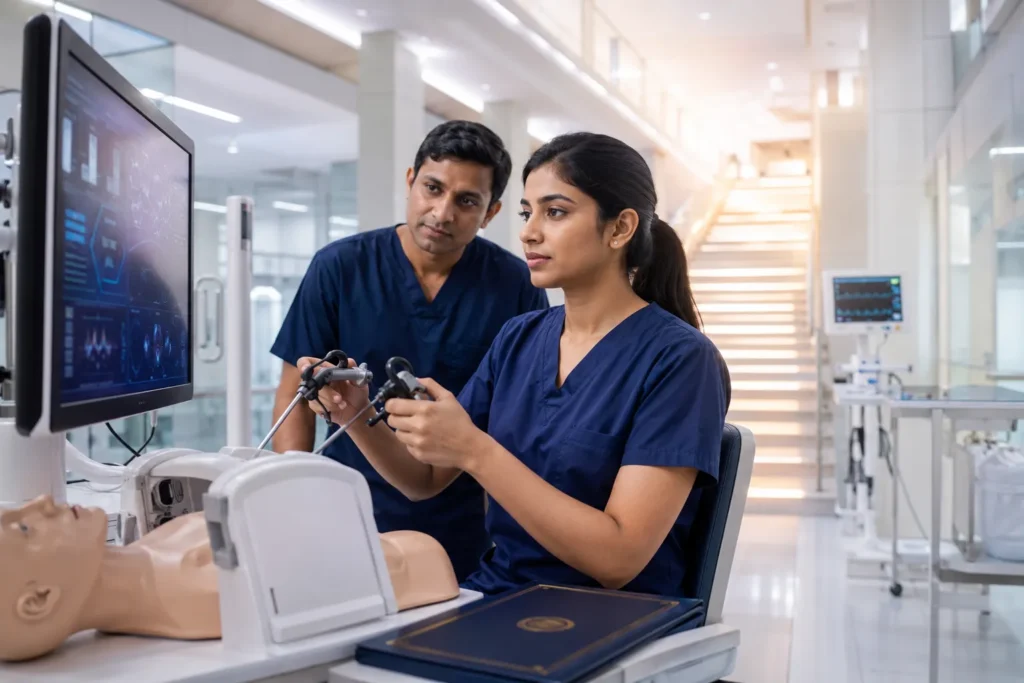
Generalist scrub technicians are common. Specialty-trained ones are not — and hospitals pay for the difference. Expect a 20–40% premium in these areas:
| Specialisation | Why It Pays More | Typical Premium |
|---|---|---|
| Cardiac / CTVS theatre | Bypass, valve and paediatric cardiac cases; perfusion support | +25–40% |
| Neurosurgery | Microscopes, navigation systems, long high-stakes cases | +20–35% |
| Organ transplant | 24×7 on-call, strict protocols, rare skill set | +25–40% |
| Robotic surgery (da Vinci) | Docking, port placement, instrument handling | +25–40% |
| Cath lab / interventional radiology | Radiation-protocol trained, hybrid OT skills | +20–30% |
| Endoscopy and laparoscopy | High-volume, camera and energy-device handling | +15–25% |
| CSSD in-charge | Autoclave validation, sterilisation audits, NABH documentation | +15–25% |
Add-on certifications that employers actually notice: BLS/ACLS, infection-control training, NABH documentation exposure, laser safety, and biomedical equipment handling.
Beyond Basic Pay – What Else You Actually Earn
When comparing two offers, look at the whole package, not the headline number:
- Night duty allowance: ₹200–₹800 per night shift in most private hospitals.
- On-call and emergency call-back pay: significant in trauma, transplant and cardiac units.
- Overtime: long surgeries regularly stretch shifts; paid OT hours add 10–20% for some technicians.
- PF, ESI and gratuity: deducted from CTC but real long-term money.
- Free or subsidised accommodation and meals: common in mission hospitals and Gulf contracts, worth ₹8,000–₹20,000 a month effectively.
- Health cover for family: standard in most corporate chains.
Operation Theatre Technician Salary Abroad (Realistic Numbers)
Working abroad is a genuine option, but the internet exaggerates the money and hides the paperwork. Here is the honest version.
| Country | Typical Annual Pay (Local) | Approx. Monthly (₹) | Entry Requirement |
|---|---|---|---|
| UAE | AED 100,000 – 170,000 | ₹2.0 – 3.4 lakh | DHA / DOH / MOH licence via Prometric exam + 2 years’ experience |
| Saudi Arabia | SAR 85,000 – 115,000 | ₹1.7 – 2.3 lakh | SCFHS registration + Prometric exam |
| Qatar / Kuwait / Oman | Comparable to UAE | ₹1.8 – 3.0 lakh | Local licensing body exam |
| United Kingdom | £25,760 – £32,073 (Band 3–5) | ₹2.5 – 3.2 lakh | Support-worker roles at Band 2–3; ODP roles need HCPC registration |
| United States | Median $62,830 | ₹4.5 – 4.8 lakh | CST certification, visa route is long and difficult |
Sources for the international figures: the US Bureau of Labor Statistics reports a median annual wage of $62,830 for surgical technologists (May 2024), with the lowest 10% under $43,290 and the top 10% above $90,700, and projects 5% employment growth from 2024 to 2034.
UK figures follow the NHS Agenda for Change pay scales effective 1 April 2026, where Band 3 starts at £25,760 and Band 5 at £32,073. Rupee conversions are approximate and move with exchange rates.
Three things to know before you chase a Gulf job:
- Most employers want 2–3 years of Indian hospital experience first. Freshers rarely get sponsored.
- You must clear a licensing exam (Prometric/DHA/SCFHS). Budget 3–6 months of preparation.
- Compare savings, not salary — a package with free accommodation, transport and annual air ticket can beat a higher cash offer.
In the UK specifically, an Indian OT technician usually cannot walk into an Operating Department Practitioner (ODP) role, because that requires HCPC registration. Most start as theatre support workers and study further.
What Actually Increases Your Salary – 8 Practical Levers
From what hospitals tell us at placement drives, these are the moves that reliably shift pay:
- Get scrub-certified across at least three specialties in your first three years. Versatility is currency.
- Choose a high-volume hospital over a high-salary one for year one. Case exposure compounds; ₹2,000 extra a month does not.
- Learn the equipment, not just the instruments. Technicians who can troubleshoot cautery, laparoscopy stacks and anaesthesia workstations get retained and promoted.
- Document your case log. Number of cases, specialties, surgeon references — this is your negotiating evidence.
- Complete NCAHP-aligned qualifications and keep your registration paperwork ready as national registration rolls out.
- Move to a specialty theatre (cardiac, neuro, transplant, robotics) by year three.
- Add supervisory skills — duty rostering, consumable inventory, NABH audit files. This is how you become OT In-charge.
- Switch employers deliberately, not frequently. In allied health, a planned move every 3–4 years usually gives a 25–40% jump; job-hopping yearly gives you a reputation, not a raise.
Career Growth Path and Salary Ladder
Operation theatre technology is not a dead-end technical job. The typical progression looks like this:
Trainee OT Technician (₹10–15k) → OT Technician (₹20–35k) → Senior/Specialty OT Technician (₹38–60k) → OT In-charge / Supervisor (₹60k–1 lakh) → OT Manager or Perioperative Services Coordinator (₹1–1.5 lakh) → Hospital Operations / Clinical Faculty / Medical Device Trainer (₹1.2 lakh+)
Two side routes are worth knowing:
- Medical device and surgical equipment companies hire experienced OT technicians as clinical application specialists and product trainers, often at ₹6–12 LPA, because they already know the theatre workflow.
- Teaching roles in paramedical institutes usually need an M.Sc. plus clinical experience and offer stable hours with ₹35,000–₹70,000 a month.
For a deeper look at role progression, read our guide to OT technician career opportunities.
Demand Outlook – Why This Field Is Growing
India’s surgical volume is rising because of an ageing population, wider insurance coverage under schemes like Ayushman Bharat, and the rapid expansion of private hospital chains into tier-2 cities.
At the same time, allied and healthcare professionals remain in short supply nationwide, and the Ministry of Health & Family Welfare has made expanding this workforce a policy priority through the NCAHP framework.
For students, the practical meaning is simple: placement is rarely the problem in this field; pay depends on how well you were trained. Hospitals will hire a competent scrub technician quickly. They will pay well for one who does not need supervision.
How to Choose an Institute (This Decides Your First Salary)
Before you pay any admission fee, check these six things:
- Curriculum alignment with NCAHP standards.
- A real hospital attachment – not a “tie-up letter”, but a working OT where you will actually scrub.
- Minimum clinical hours clearly written in the prospectus.
- Faculty who are practising surgeons, anaesthetists or senior OT technologists.
- Placement track record with named hospitals and verifiable alumni.
- Recognised certification that government and corporate employers accept.
At Global A1 Institutes in Gurugram, students train inside a working hospital and trauma centre with doctor-led instruction, which is what turns a certificate into an offer letter. Explore the Operation Theatre Technician course or browse all paramedical courses to compare options.
Conclusion
The realistic 2026 operation theatre technician salary in India runs from about ₹14,000 a month as a fresher to ₹60,000–₹1,00,000 a month for senior and supervisory technicians, with specialty theatres, government posts and Gulf jobs at the top end.
This is not a field where you get rich in year one — it is a field where trained, specialised, well-documented technicians earn steadily more every three years, and where the job itself is stable because surgery does not stop.
The single decision that matters most is where you train. A programme with real theatre hours, doctor-led teaching and NCAHP-aligned curriculum will put you at the top of the fresher band instead of the bottom of it.
Ready to start? Explore the Operation Theatre Technician course at Global A1 Institutes, or speak to our career team about which allied health path fits you best.
Frequently Asked Questions
Q1. What is the starting operation theatre technician salary in India in 2026?
Most freshers earn ₹14,000 to ₹25,000 per month (₹1.7–3.0 LPA). Some hospitals begin with a 3–6 month training stipend of ₹8,000–₹15,000 before confirmation.
Q2. Do government or private hospitals pay more?
Private hospitals often pay more in the first two years. Government posts pay more over a career — central government technician grades sit at 7th CPC Pay Levels 4–6 (basic ₹25,500 to ₹1,12,400) plus DA, HRA and pension benefits.
Q3. What is the operation theatre technician salary after 5 years?
Typically ₹38,000 to ₹60,000 per month, and higher in cardiac, neuro, transplant or robotic theatres where a 20–40% specialty premium is common.
Q4. Which course gives the highest OT technician salary?
B.Sc. in Operation Theatre Technology (or B.Sc. AOTT) gives the strongest start among undergraduate options, and an M.Sc. opens supervisory, teaching and administration roles paying ₹35,000–₹70,000 a month.
Q5. Which cities pay the best?
Mumbai, Delhi NCR, Bengaluru and Hyderabad lead, with senior technicians reaching ₹45,000–₹50,000 a month in private hospitals. Adjust for cost of living before you decide.
Q6. Can an OT technician work abroad, and how much do they earn?
Yes. In the Gulf, packages typically run ₹1.7–3.4 lakh per month equivalent, after clearing a Prometric or local licensing exam with 2–3 years’ experience. UK NHS support roles start around Band 3 (£25,760 from April 2026), and the US median for surgical technologists is $62,830 per year.
Q7. Is OT technician a good career in 2026?
Yes, if you want clinical work without a long medical degree. Demand is steady, entry is fast, and the ceiling is higher than most people assume once you specialise.
Q8. What is the difference between an OT technician and an OT assistant?
An OT technician is trained to scrub, handle instruments and manage equipment. An OT assistant or attendant handles patient shifting, cleaning and support tasks and is paid on a lower grade. Check the designation on your offer letter – the title determines the pay scale.
Q9. Do OT technicians need registration in India?
Registration is being rolled out under the NCAHP Act, 2021, with NCAHP maintaining central and state registers of allied and healthcare professionals. Choosing an NCAHP-aligned programme now avoids problems later.
Q10. Can an OT technician become a surgeon?
No. OT technicians assist surgical teams; performing surgery requires an MBBS with postgraduate surgical training. However, OT technicians can move into perioperative management, teaching, or clinical roles with medical device companies.